

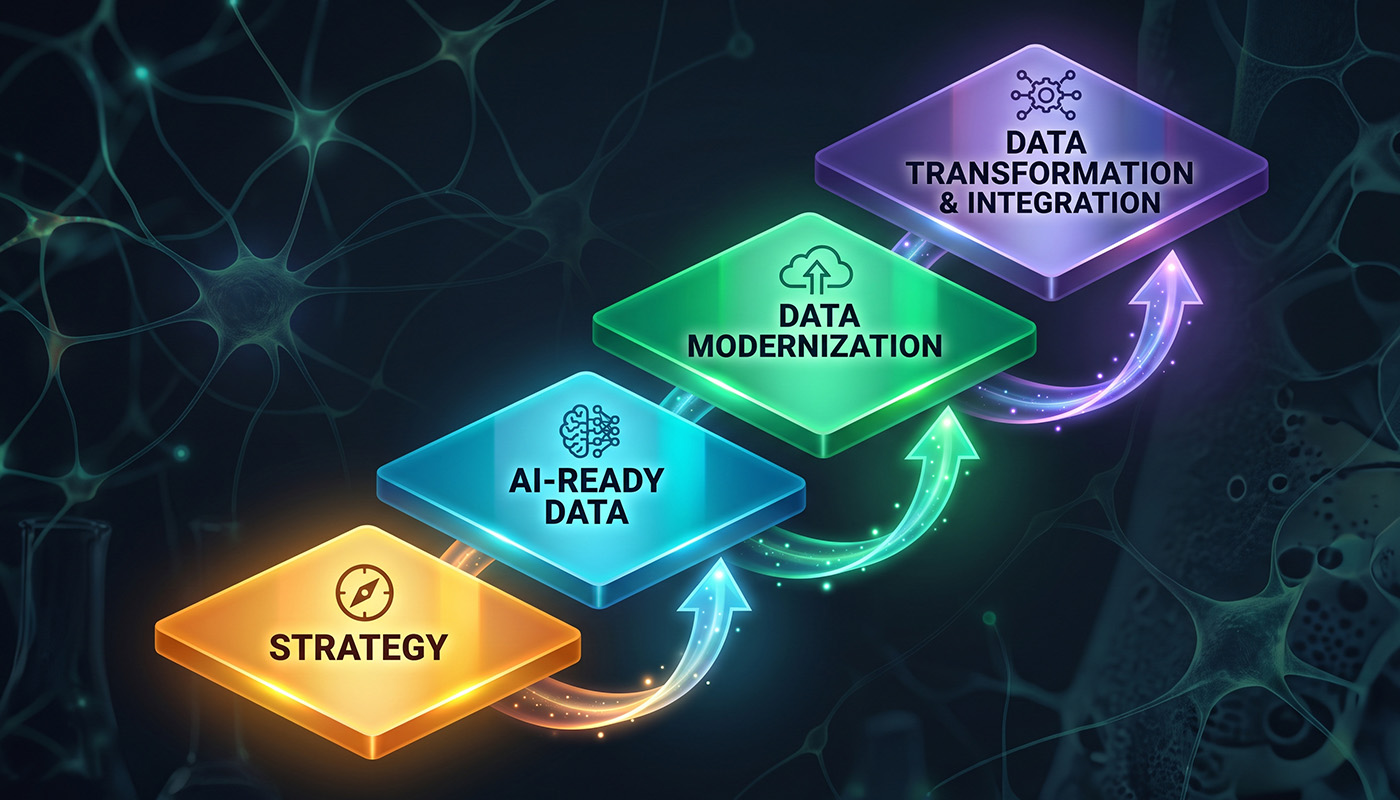
Most firms sell you a roadmap or a data pipeline—rarely both, and rarely connected. A better approach is to design your informatics ecosystem so that your strategic roadmap and your AI-ready data foundation are the exact same plan. Of course, this is much easier in theory than it is in practice. (Spoiler alert: An expert consultant makes it possible.) The information on this page represents the outline for a master map of how the pieces fit together—and then helps you identify the ideal starting point for your organization. We want you to understand the value of the data ecosystem and be confident that CSols can guide you through the transformation process.
{{cta:beyond-lims-selection-designing-the-modern-lab-informatics-ecosystem}}
Why a Technology Ecosystem Is Better Than Disjointed Services
- A strategic roadmap built without an AI-ready data foundation stalls the moment implementation begins.
- A FAIR data foundation built without an overarching strategic roadmap solves today’s immediate integration problem while missing out on tomorrow’s scalable vision.
- Strategic Consulting & Advisory Services defines where you are going and why.
- AI Lab Data Services builds the rock-solid ground it stands on.
- Data Modernization and Data Transformation & Integration carry your lab’s data safely into day-to-day execution.
As alluded to previously, this is much more complicated in practice than it appears on the screen. It’s expensive and time consuming. But it is something that dedicated laboratory informatics consultants are well equipped to do. More important, it’s something that labs need to do if they want to keep up with the increasing flow of data from samples and experiments and to researchers and decision makers.
Taking an ecosystem approach from the start makes the downstream efforts much easier.
- It can dramatically reduce the amount of customization required, which makes upgrades simpler.
- It can improve the flow of data among systems, which makes deploying AI models possible.
Four Pillars, One Technology Ecosystem
Remaking your lab’s data flow into a connected ecosystem opens up many more possibilities for efficiency and revenue increases. When you can deploy an AI agent to pull reports or identify trends, you save time and create room for predictive modeling.
1. Strategic Consulting & Advisory Services
Begin with independent, vendor-neutral roadmaps for LIMS/ELN or other system selection, informatics program design, and digital transformation strategy. These can be built from day one with AI outcomes in view, not bolted on after the fact. In today’s labs, this should be the first consideration when evaluating an informatics system.
Explore Strategic Consulting & Advisory Services
2. AI Lab Data Services
A hard look at the data underpinning your systems should happen together with attention to the overarching strategy. The foundation your strategy depends on must include FAIR-compliant data, standardized ontologies, instrument-level integration, and GxP-compliant governance that makes your data usable by AI, not just stored in silos.
3. Data Modernization
If you’re lucky enough to work at a successful company with more than 10 years of data, chances are you’re dealing with legacy systems. These often lack an easy way to communicate with newer systems, either due to hardware constraints or proprietary code. (Does anyone else remember both kinds of floppy disk?) At any rate, you’ll want a legacy system modernization plan and a cloud/hybrid architecture that can carry both the strategy and the AI-ready foundation into a scalable, future-proof environment.
4. Data Transformation & Integration
The final piece is the connective layer. Your instruments, LIMS, ELN, CDS, and SDMS can be integrated for sharing data in real time, so every dataset reaches the people and systems that need it. This is the last hurdle to achieving AI readiness. Once your data has a common language and an easy pathway to move within and among systems, your ability to access insights from that data increases exponentially.
Explore Data Transformation & Integration
Your Starting Point for Building a Technology Ecosystem
The following access points will resonate with labs at different stages of the AI ready journey. Which of these statements most closely aligns with your needs?
"I need a roadmap and executive buy-in for our AI/digital transformation."
→ If this sounds like you, you’re likely a Transformation Sponsor (VP/Director, R&D IT, or Digital Lab Manager). Start with Strategic Consulting.
"I need our lab data cleaned, connected, and actually usable by AI tools."
→ People at this point in their journey are likely an Informatics Architect or Data Architect (Associate Director, Scientific Computing or Data Architecture). Start with AI Lab Data Services.
"I'm responsible for both—the strategy and making it real."
→ When you reach this point in a data journey, you’re the Ecosystem Owner this blog was written to support. You’re prepared to take this information to heart and build a true technology ecosystem.
If you’re not sure where to start, or you need help identifying where your lab falls on the AI readiness curve, take the quick, 15-question AI data readiness assessment. Not knowing where to start can create decision paralysis. The assessment helps you get unstuck.
One Technology Ecosystem, One Accountable Partner
Most organizations end up cobbling together a strategy consultant, a laboratory informatics vendor, a data engineer, and an integration contractor—and then working around the inevitable gaps between them.
CSols designs the whole ecosystem as one accountable engagement, from the boardroom roadmap to the instrument-level data pipeline. This produces a seamless structure built intentionally from the foundation to the AI model that drives predictive modeling. Talk to an Ecosystem Strategist and we’ll scope a combined engagement.
How could a unified laboratory data ecosystem move your lab forward?



.jpg)
.png)
Comments