Build the FAIR, GxP-Compliant Data Foundation Your AI Models Need to Succeed

Most laboratory AI initiatives stall because algorithms are built on top of fragmented, unstandardized data. Harmonize your instruments, LIMS, and ELNs into a governed, FAIR-compliant data ecosystem—eliminating up to 50% of manual data wrangling so your scientists can focus on discovery while maintaining full 21 CFR Part 11 and ISO 42001 audit readiness.

Why Data Standardization Determines Whether Your Lab AI Succeeds or Fails

AI-ready lab data requires unified data architecture, standardized scientific ontologies, and automated governance across every instrument and informatics platform. Without standardized metadata, your AI agents cannot reliably retrieve or interpret results—creating critical bottlenecks during product recalls, customer investigations, and regulatory audits.
Instead of leaving your scientists to manually clean and reformat spreadsheets, you get a connected, machine-readable data foundation that turns raw bench outputs into reproducible, audit-defensible insights.
Standardized, unambiguous data—supported by CSols partners—can be analyzed by AI in seconds, producing accurate reports, trends, and decisions that are scalable and reproducible.

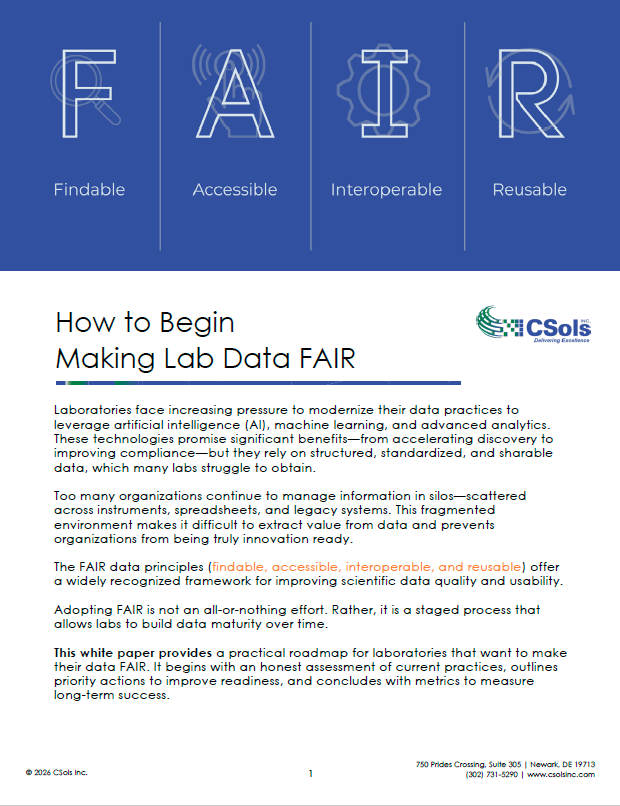
How to Begin Making Lab Data FAIR

How Your Lab Becomes AI Ready: A 4-Pillar Engineering Framework

Move from isolated informatics tools to a unified data supply chain without disrupting daily bench operations:

Automated Instrument & Platform Aggregation

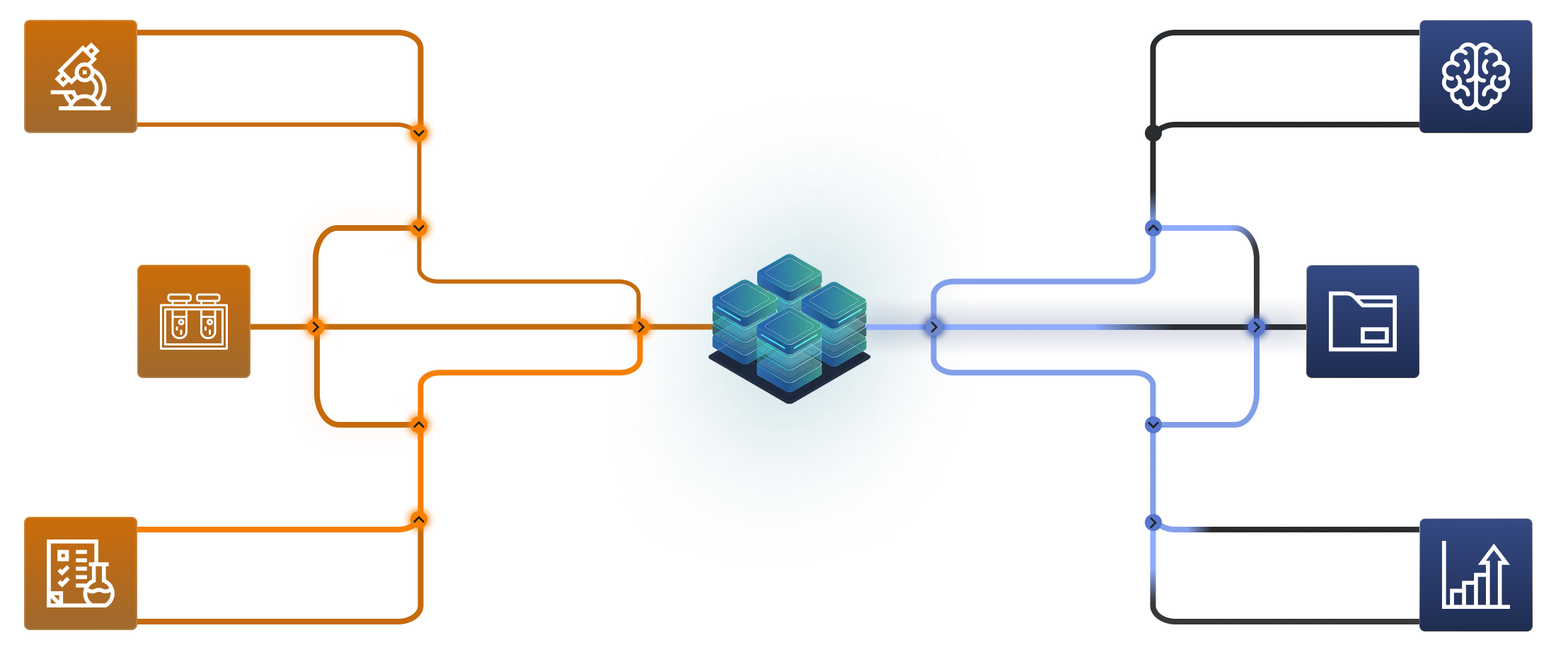
We help you move beyond simple data storage to enable dynamic data aggregation—integrating instruments with science-aware platforms and orchestration hubs to ensure every data point is automatically translated and accessible for AI use, regardless of the source or destination platform

Scientific Ontology & Metadata Normalization

Eliminate naming ambiguities across sites and legacy databases. Establish standardized scientific ontologies so your AI tools can determine (for example) that muriatic acid, hydrochloric acid, and HCl all describe the same entity.

Real-time Contextual Integrations

Connect historical datasets with live operational streams to give machine learning models full experimental context—cutting manual data wrangling time by up to 50%.

Built-in AI Regulatory Compliance

Deploy AI pipelines engineered for FDA 21 CFR Part 11, ISO 17025, ISO 42001, and the FDA's latest draft guidance on Artificial Intelligence—complete with unalterable audit trails and full data provenance.

Is Your Lab AI Ready?

Solve the Data Bottlenecks Stalling Your Lab AI

To harness the power of AI, organizations must first resolve the systemic data fragmentation that compels highly skilled scientists to do manual data processing.

Reclaim Scientist Hours

Life science organizations are racing toward AI-driven discovery, yet Ph.D.-level talent is often spent on manual effort (data entry, re-entry or repeat work) due to data being trapped within silos.

Decisions require full datasets that span data sources (silos); manual effort for this is overwhelming at times. We provide technical remediation to eliminate silos at the source.

Capture Bench-level Context From Day One

Generalist firms often sell high-level AI insights but ignore the foundation.

AI must start at the bench.

Without automated metadata capture and standardized ontologies from day one, your models will be delayed by years of legacy data cleaning.

Connect Systems Without Ripping and Replacing

Instead of replacing your existing LIMS and ELNs, we add a data layer that connects instruments, systems, and analytics into a governed, AI-ready flow. We focus on four technical pillars of the FAIR data principles:
  • Findable: Centralized data search and discovery.
  • Accessible: Secure, governed cloud data storage.
  • Interoperable: Machine-readable, standard lab ontologies.
  • Reusable: Automated metadata and data provenance.
Together, these four pillars turn your existing lab systems into an integrated, FAIR, AI‑ready data supply chain—without a disruptive workflow overhaul.

AI-Ready Lab Data Services FAQs

Explore our FAQs to get the answers you need, or visit our Knowledge Bank for more detailed information.

Our LIMS/ELN vendor says their platform is already 'AI-ready.' Why do we need additional data services?

A single "AI-ready" LIMS or ELN only organizes data inside its own walls, whereas meaningful lab AI requires harmonized data across multiple instruments, ERP systems, and legacy archives. Vendor tools rarely normalize cross-platform ontologies or clean historical dark data—leaving critical blind spots in your predictive models and batch investigations.

How can we reduce manual data wrangling?

Data scientists currently spend a majority of their time manually cleaning and formatting messy legacy data. CSols implements a data supply chain architecture that automates metadata capture and uses standardized ontologies, reducing manual data wrangling and accelerating R&D cycles by up to 50%.

What is the impact on current production operations during the AI readiness implementation?

We take a low-disruption approach using our FAIR Readiness Roadmap focused on laboratory and related data. We identify quick wins that provide immediate value to scientists at the bench while minimizing production downtime and building the long-term infrastructure required for advanced analytics.

Why Labs Trust CSols for AI Data Readiness

Algorithms are commodities; clean, contextualized, audit-ready scientific data is your true competitive advantage. With over 20 years of specialized laboratory informatics experience, CSols builds the governed data foundation your AI models need to deliver safe, reproducible breakthroughs.