

A fundamental question that many people new to the informatics world ask is “What does a LIMS do?” Well, at its core the answer is simple, but there are a few layers to get through to fully grasp what the system can do. Simply put, a Laboratory Information Management System (LIMS) improves lab efficiency, accuracy, and speed by reducing manual work and errors.
Now you might be wondering “How does it do that?” Let’s peel back the layers and take a look.
{{cta:the-lims-comparison-guide-navigating-the-lims-landscape}}
The Core Layer—LIMS Infrastructure
The innermost core layer, or lowest layer, is the infrastructure of the LIMS. This can vary depending on the system, but here are a few different configurations that can be done. Keep these definitions in mind when choosing a deployment model:
- Desktop-focused architecture: The LIMS application is installed on individual workstations, and the database on a centralized server. The client provides the infrastructure for data processing.
- Browser-based access: Users interact with the LIMS entirely through a web browser, with all application logic and the database hosted on a server that the client may or may not maintain.
- Hybrid architecture: Desktop applications with browser components allow some functionality to run locally.
- Cloud-first architecture: Most client-side processing is handled through a browser, with the system hosted in the cloud and allowing remote access.
Choosing the best architecture will depend on the needs of your lab and the capabilities of your organization’s IT department. Generally, cloud-first architecture is the most popular because it scales well, has fast deployment and updates, and good cost efficiency; but each lab needs to be assessed to see what would work best for them.
The Functionality Layer—LIMS Application Capabilities
The next layer above the infrastructure is the functionality of the LIMS itself. This is the lab data management layer that most people are interested in. This functionality layer enables the laboratory to operate efficiently and maintain data integrity. A convenient way to view LIMS functionality is by laboratory process, which typically includes sample login and registration, assignment of tests and scheduling of work, quality control of samples and instruments, data recording and storage, review and approval of results, and sample reporting.
In practice, each LIMS will offer different functionalities, but most LIMS provide a set of features that are generally available across platforms. Such processes/features include:
- Sample management
- Data capture
- Workflow automation
- Instrument and application integration
- Review and approval of results
- Trending and reporting
- Barcode handling
- Compliance with regulatory standards (including electronic signatures and audit logs), instrument calibration and maintenance
- Inventory management
- Study and stability study management
- Document management
- Personnel/workload management
This is the layer that will give the lab team the tools they need to manage day-to-day operations easily and efficiently.
The Reporting and Analytics Layer—Making Sense of Your LIMS Data
A critical layer of a LIMS focuses on making laboratory data useful and actionable. This includes:
- Reporting
- Dashboards
- Trend analysis
- Predictive analytics
- Key performance indicators
- Compliance support (auditing)
Using this data your lab can identify bottlenecks, optimize processes, and start predicting trends. This layer ensures that information is accurate, accessible, and meaningful, helping laboratories improve efficiency and maintain compliance.

The Invisible Layer—LIMS Compliance and Data Integrity
Compliance must be discussed in depth because in regulated environments a LIMS isn’t a LIMS isn't just a database; it is a compliance engine specifically designed to enforce data integrity automatically. A validated LIMS provides assurance that your data is secure.
- The Audit Trail:
Every click, change, and result is time-stamped and attributed to a user. This eliminates the "Who wrote this in the margin of the notebook?" headache. - ALCOA+ Principles:
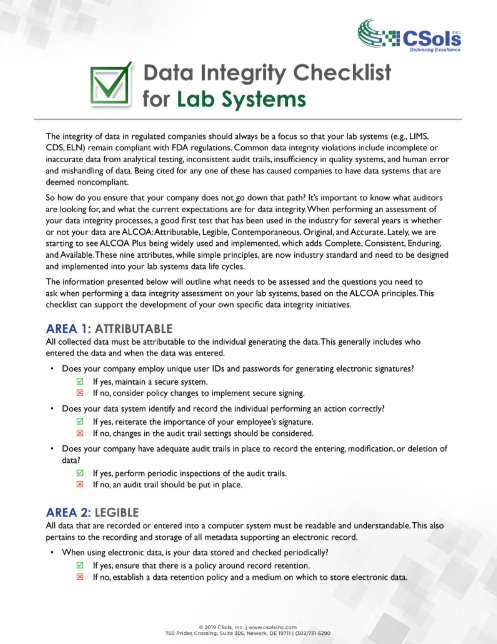
A LIMS ensures data is Attributable, Legible, Contemporaneous, Original, and Accurate (ALCOA) plus Complete, Consistent, Enduring, and Available. - Reduced Human Error:
A LIMS performs the necessary math automatically, eliminating costly transcription and calculation errors.

The Integration Layer—Connecting LIMS With the Ecosystem
A LIMS shouldn't be isolated software. To realize its full power, it can be integrated into the rest of the organization.
- Instrument Interfacing:
Instead of a scientist manually typing numbers from an HPLC into a spreadsheet, the LIMS grabs the data directly. This is a massive time-saver. - ERP/Enterprise Integration:
A LIMS can talk to SAP or Oracle. When the lab approves a batch, the LIMS can automatically tell the warehouse the product is released for sale. - ELN Integration:
An Electronic Lab Notebook (ELN) handles unstructured research data, while the LIMS manages the structured, process-driven data. Connecting the two provides much more flexibility to analyze your data for trends.
Working With the LIMS
A LIMS will change the way your lab staff works, for the better.
Before LIMS: A scientist spends too much time hunting for paper folders, transcribing instrument data, manually checking if a reagent is expired, and handwriting labels.
After LIMS: The system alerts your lab staff to expired reagents automatically, labels are printed via barcode with one click, files and instrument data move through the system automatically, and your staff can spend their time doing science rather than managing paperwork.
So, the LIMS stack can be summarized as:
- Core Layer: Comprises servers, storage, cloud or on-prem hosting, networking, and security.
- Functionality Layer: Provides sample management, workflows, data capture, approvals, reporting, and lab operations.
- Reporting and Analytics Layer: Offers dashboards, reporting, trend analysis, and decision-support tools.
- Invisible Layer: Enforces ALCOA+ principles, ensuring your data is always audit-ready.
- Integration Layer: Connects your LIMS directly to lab instruments, enterprise software, and other informatics systems to eliminate manual data entry.
This is just a high-level overview of what LIMS can do. A consultation with CSols can help if you’d like more in-depth information about how a LIMS can improve your lab!
Are you curious about anything else that a LIMS can do?



.jpg)

.png)

.png)


Comments