ALL ANSWERS IN ONE PLACE

BUSINESS ANALYTICS
Turn Fragmented Data Into Faster Decisions and Audit-ready Intelligence
Unify data across your LIMS, ELNs, instruments, and ERP systems into a single source of truth. Gain real-time visibility into sample turnaround times, resource bottlenecks, and batch quality—without manual spreadsheet wrangling or compliance risks.
Why Unified Lab Analytics Matters for Regulated Operations
Laboratory business analytics connects siloed scientific and operational data so your teams can reduce cycle times, cut rework, and maintain continuous audit readiness.
When critical test results are trapped in legacy LIMS, standalone instruments, or manual spreadsheets, your scientists waste hours compiling reports instead of advancing R&D and quality release. A unified analytics foundation gives your leadership instant, trustworthy metrics across every site.

WAY FORWARD
How We Build Your Analytics Ecosystem
Every lab has distinct informatics platforms, regulatory obligations, and throughput goals. Your analytics roadmap is built around five core pillars designed to move your team from manual reporting to predictive intelligence:
Goal-first Data Strategy
Get an actionable roadmap that aligns your informatics architecture with your business goals and identifies the right-fit vendor platforms for your budget and scale.

Multi-system Data Integration
Eliminate manual data exports. Connect legacy systems, lab instruments, LIMS, ELNs, and cloud platforms into an AI-ready scientific data ecosystem where historical and real-time results merge cleanly.

Self-service Reporting & Visualization
Put interactive, role-based dashboards in the hands of lab managers and executives—turning complex assay, batch, and throughput data into clear visual trends you can act on immediately.

Predictive and Prescriptive Analytics
Move beyond looking at past performance. Use machine learning models trained on your historical lab data to forecast testing bottlenecks, predict instrument maintenance needs, and optimize analyst scheduling.

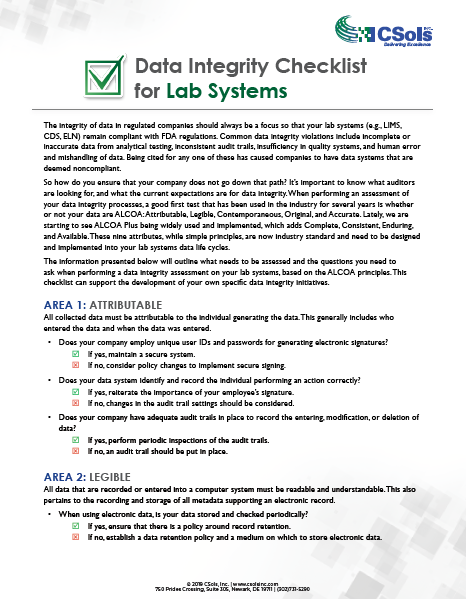
ALCOA+ Data Governance & Compliance
Trust every number on your dashboard. Establish automated validation, security, and data integrity controls engineered for regulated life sciences and FDA compliance.


SOLVING PROBLEMS
Addressing Your Toughest Lab Data Bottlenecks
Managing data challenges can slow progress and impact decision making.
High-volume Instrument & Assay Data
When instrument outputs outpace your team's ability to organize them, critical trends get buried. Your outcome: Automated ingestion pipelines that structure raw scientific data for instant querying.
Read More
Disconnected LIMS, ELN, and ERP Silos
Exporting CSVs across multiple sites slows down batch release and introduces human error. Your outcome: A connected ecosystem with a single, enterprise-wide view of lab operations.
Read More
Inconsistent or Incomplete Records
Flawed data erodes executive trust and creates audit vulnerabilities.
Your outcome: Automated data cleansing and integrity checks that guarantee reliable, defensible metrics.
Your outcome: Automated data cleansing and integrity checks that guarantee reliable, defensible metrics.
Read More
Audit & Regulatory Exposure
Manual reporting struggles to prove data lineage during inspections.
Your outcome: Built-in governance aligned with ALCOA+ and FDA 21 CFR Part 11 principles.
Your outcome: Built-in governance aligned with ALCOA+ and FDA 21 CFR Part 11 principles.
Read More
Can CSols build analytics dashboards if our data is stored across multiple different LIMS or ELNs?
Yes. One of the primary challenges in laboratory business intelligence is fragmented data. We specialize in aggregating data from disparate sources—including various informatics platforms, ERPs, and even legacy spreadsheets—into a unified data layer. This allows for enterprise-wide visibility and single source of truth reporting, regardless of how many different systems your global sites are using.
How do you ensure our analytics are based on high-quality, clean data?
Analytics are only as good as the underlying data. Before building visualizations, we perform a data integrity and quality assessment. We identify gaps, inconsistencies, and silos in your current workflows and implement automated data cleansing and transformation processes. This ensures your executive dashboards are built on a foundation of ALCOA+ compliant data, giving you full confidence in your strategic decisions.
Does CSols provide advanced predictive analytics or just descriptive reporting?
We offer both. Although descriptive analytics tell you what happened (e.g., sample turnaround times or resource use), we also help laboratories move toward predictive and prescriptive analytics. By leveraging your historical data and modern machine learning models, we can help you forecast laboratory bottlenecks, predict instrument maintenance needs, and optimize resource allocation before issues arise.


CSOLS ADVANTAGE
Why Regulated Labs Choose CSols for Business Analytics
General IT consultancies understand dashboards, but they rarely understand GxP validation, instrument integration, or scientific workflows. With over two decades of dedicated laboratory informatics experience across life sciences, pharma, chemical, and public health organizations, CSols bridges the gap between bench science and executive business intelligence—ensuring your analytics platform is both technically sound and audit-ready from day one.