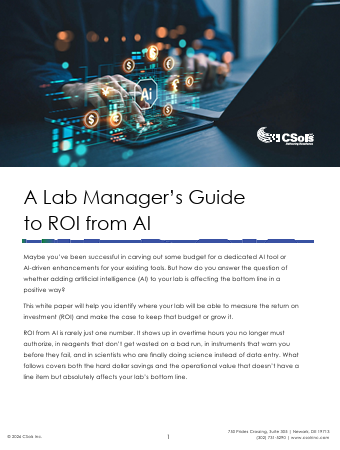
A Handful of Digital Tools Is Not a Digitalization Strategy

Achieve true lab digital maturity. Learn how data readiness, integration, and strategy drive successful digital transformation and avoid costly pitfalls.
February 19, 2026
Blog: A Handful of Digital Tools Is Not a Digitalization Strategy
TL:DR: This blog post highlights that true digital maturity in 2026 requires adopting a unified data strategy in preference to fragmented tools, prioritizing data readiness, and building a scientific digital backbone to achieve the full ROI of AI and Industry 4.0.

In the lab of 2026, technology is everywhere, but true digital maturity is surprisingly rare. When a lab looks modern on the surface but still relies on manual workarounds behind the scenes, they’re presenting a digital façade. If scientists spend 10 hours a week on data transcription or repeat two-thirds of experiments because results are lost in siloed systems, they aren’t digitally mature. 

However, digital transformation must be approached strategically and methodically. Partial automation often can be more expensive than manual processes because of the labor required to bridge disconnected systems. It’s much more expensive to rebuild a foundation after the house has been painted and furnished than it is to do it right from the ground up the first time. In a data strategy engagement with CSols, we advocate doing the necessary data readiness work before attempting to become digitally mature. 

Skipping steps in the lab digitalization process makes achieving a successful digital transformation exponentially more difficult, as some organizations have discovered to their regret. When an organization invests US$15 million or more in a massive IT project, it is critical that the experts charged with orchestrating that project can deliver it on time, on budget, and on value. This is too often not the case.

Our experiences show that as data moves to the forefront of organizational growth strategies, ensuring its foundation is sound becomes ever more important. This blog post serves as a roadmap for our clients, helping them move past the common pitfalls of fragmented adoption and join the few labs that have achieved full, seamless integration.

Current State of Lab Digitalization

The transformation of lab data is no longer a future goal; it’s a 2026 reality. Although a majority of pharmaceutical labs of all sizes use AI or automation, only a small minority (15%–20%) have achieved full integration. This integration gap is where ROI goes to die. 

For example, a mid-tier pharmaceutical client was using a stand-alone, non-networked chromatography data system (CDS). Their scientists had to manually copy all raw data into an Excel spreadsheet to consider it validated for reporting. By moving the site to a global, validated CDS system, CSols eliminated the need for these spreadsheets. The lab reclaimed several hours per week per scientist that had previously been lost to manual data transcription. 

Data from different sources (quality, procurement, R&D) often tells different stories. Weaving them into a single narrative can address the gap and ensure that your IT strategy supports the entire product lifecycle—from discovery to batch release. But it’s difficult to get right, and it requires that all your data is harmonized before you start. 

Taking the time for data harmonization will pay dividends down the road. Investing in data readiness before attempting full integration lets labs minimize the budget overruns or failures that often plague large-scale integration projects.

The Human Toll: Operational Burnout

Fragmentation doesn't just lose data; it drains high-value scientific talent. A multinational chemical company client faced a failed global LIMS implementation across seven sites. Poor system performance and a lack of internal expertise led to extremely low user adoption and widespread staff frustration. 

CSols provided senior leadership to salvage the implementation, using a modified Agile approach and managing timelines through grouped-site gap analyses. The project was reignited, resulting in a functional, standardized global system and a structured approach that the client now applies to other projects. When digitalization fails the user, the cost isn't just financial—it's cultural.

Existing Tools as a Constraint

Siloed data is as much a mind-killer as fear (any Dune fans out there?). Just as the spice must flow, your data must flow without friction for your lab to survive the shifting sands of regulations. Users often cite ELNs as a roadblock to data flow more than a recordkeeper. A recent survey by Sapio Sciences uncovered a clear mismatch between existing tools and modern scientific needs. Although implementing an ELN seems to tick the box of digital transformation, it is not enough when done in isolation. 

Most legacy ELNs are designed as systems of record (filing cabinets) rather than systems of reasoning. ELNs are notoriously difficult to configure or adapt for new experiments, with 71% of the Sapio Sciences survey respondents reporting this issue. Finding prior experimental results is also a problem: 65% of respondents reported having to repeat experiments because they couldn’t find them. Far from a minor inconvenience, this represents waste of high-cost reagents, instrument time, and PhD-level labor on a massive scale.

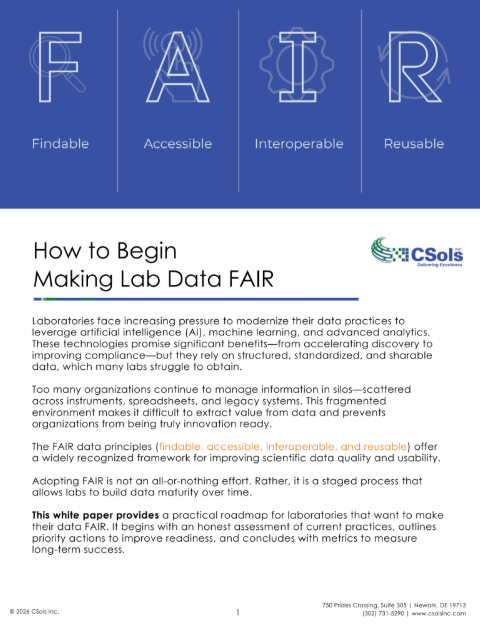
More worrisome, only 5% of scientists report feeling capable of analyzing their results on their own. These scientists are increasingly turning to AI for help with organizing and analyzing their data. As we should know by now, data is much more conducive to analysis when it is findable, accessible, interoperable, and reusable (FAIR)

Industry 4.0 Business Cases

A lab digitalization project often allows for greater organizational integration as well. Opportunities for cost savings will present themselves when a data backbone approach is adopted. Modern organizations still view Quality as a cost center. It serves as insurance against regulatory risk. However, Quality 4.0 transforms this vital function into a profit center in a true win–win situation. A digital backbone does more than just check boxes and hedge against risk; it captures millions in reclaimed efficiency.

Traditional paper-based batch reviews are a notorious bottleneck that require time-consuming manual cross-referencing. Implementing and validating electronic Quality Management Systems and digital workflows allows for review by exception, focusing human eyes only on the anomalies. When the majority of U.S. Food and Drug Administration warning letters are linked to documentation issues, this time savings also translates to risk reduction.

Your procurement team might be buying the latest tech, but that doesn't mean your lab is ready to use it. A 2026 report reveals that although 100% of procurement leaders are now using AI, only 11% report being fully ready to leverage it. The top reason cited for this gap? Inadequate data quality and cross-system integration (54%). Without rigorous data cleansing before AI adoption, such tools can give incorrect suggestions based on dirty data.

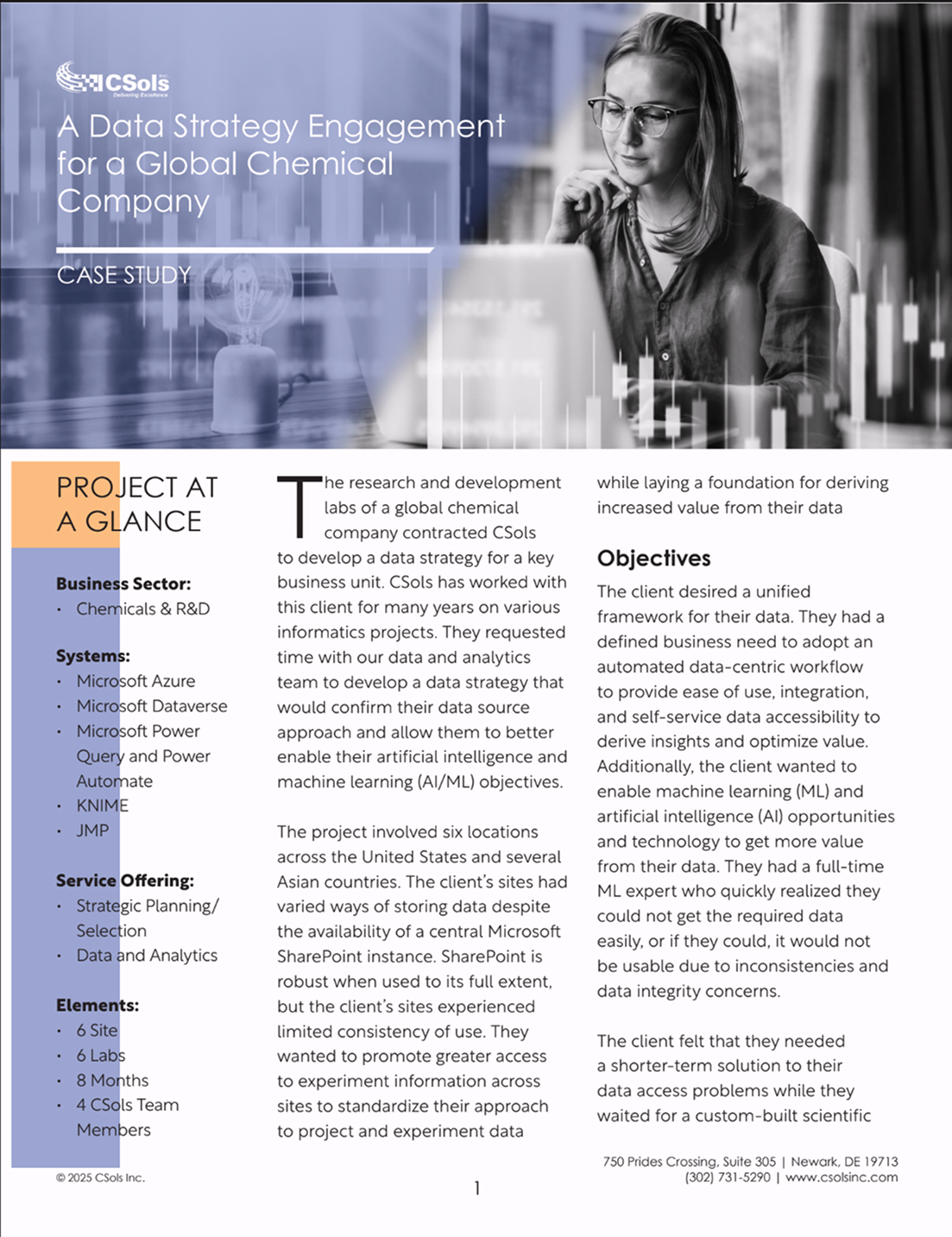
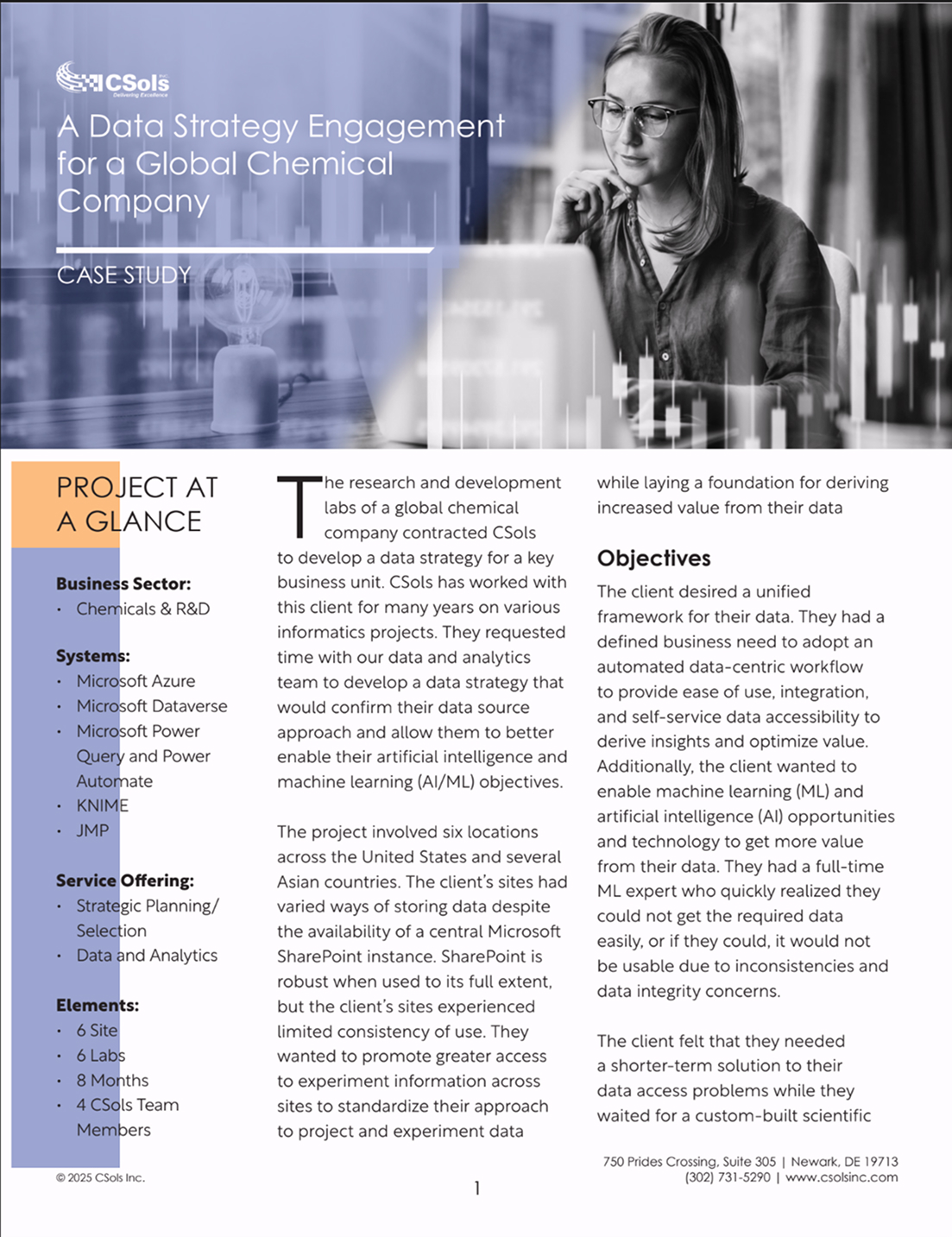
In the R&D space, the problem is more often dark data. We recently helped a global chemical company bring some of their dak data to light. Although they had a full-time machine learning (ML) expert, the expert was essentially a 'data janitor' because their siloed R&D records weren't AI ready. By building a unified data strategy across six global sites, we helped them reclaim their human dividend, allowing their scientists to focus on innovation while ensuring their data was finally machine readable. Once data has been made FAIR, agentic AI can be deployed—autonomous agents that don't just find data but act on it to predict the next successful experiment.

Benefits of Lab Digitalization Success

Building a digital backbone is the first step to reducing data siloes and increasing cost savings. Recent research from McKinsey suggests that 25% to 35% of quality control labs can reduce costs with digitalization, through three specific aspects:

  • Reduced documentation labor
  • Optimized scheduling
  • Decreased deviation workloads

These benefits make lab digitalization a quantifiable financial strategy that makes sense to the whole organization. However, although complete data harmonization should be your goal, you don’t have to start there. Integrating existing tools and visualizing your hidden data can produce dramatic, low-level efficiency gains.

Sometimes, the digital façade is a slow system that only looks modern. We recently worked with a client where critical reporting queries took 18 minutes to load, stalling productivity across Manufacturing and Quality. By integrating Tableau to visualize server performance and optimizing the underlying code, CSols reduced that wait time to 50 seconds. Using the tools the client already owned, we reclaimed hours of scientific dead time and provided a clear, visual roadmap for future growth.

These benefits make lab digitalization a quantifiable financial strategy that makes sense to the whole organization. The experienced laboratory informatics consultants at CSols can get you started on a lab digitalization path that will lead to success.


What is your lab digitalization strategy? 

Comments

Leave a reply. Your email address will not be published. Required fields are marked *
This site uses Akismet to reduce spam. Learn how your comment data is processed.
Thank you! Your submission has been received!
Oops! Something went wrong while submitting the form.

A Handful of Digital Tools Is Not a Digitalization Strategy

Achieve true lab digital maturity. Learn how data readiness, integration, and strategy drive successful digital transformation and avoid costly pitfalls.

Achieve true lab digital maturity. Learn how data readiness, integration, and strategy drive successful digital transformation and avoid costly pitfalls.

TL:DR: This blog post highlights that true digital maturity in 2026 requires adopting a unified data strategy in preference to fragmented tools, prioritizing data readiness, and building a scientific digital backbone to achieve the full ROI of AI and Industry 4.0.

In the lab of 2026, technology is everywhere, but true digital maturity is surprisingly rare. When a lab looks modern on the surface but still relies on manual workarounds behind the scenes, they’re presenting a digital façade. If scientists spend 10 hours a week on data transcription or repeat two-thirds of experiments because results are lost in siloed systems, they aren’t digitally mature. 

However, digital transformation must be approached strategically and methodically. Partial automation often can be more expensive than manual processes because of the labor required to bridge disconnected systems. It’s much more expensive to rebuild a foundation after the house has been painted and furnished than it is to do it right from the ground up the first time. In a data strategy engagement with CSols, we advocate doing the necessary data readiness work before attempting to become digitally mature. 

Skipping steps in the lab digitalization process makes achieving a successful digital transformation exponentially more difficult, as some organizations have discovered to their regret. When an organization invests US$15 million or more in a massive IT project, it is critical that the experts charged with orchestrating that project can deliver it on time, on budget, and on value. This is too often not the case.

Our experiences show that as data moves to the forefront of organizational growth strategies, ensuring its foundation is sound becomes ever more important. This blog post serves as a roadmap for our clients, helping them move past the common pitfalls of fragmented adoption and join the few labs that have achieved full, seamless integration.

Current State of Lab Digitalization

The transformation of lab data is no longer a future goal; it’s a 2026 reality. Although a majority of pharmaceutical labs of all sizes use AI or automation, only a small minority (15%–20%) have achieved full integration. This integration gap is where ROI goes to die. 

For example, a mid-tier pharmaceutical client was using a stand-alone, non-networked chromatography data system (CDS). Their scientists had to manually copy all raw data into an Excel spreadsheet to consider it validated for reporting. By moving the site to a global, validated CDS system, CSols eliminated the need for these spreadsheets. The lab reclaimed several hours per week per scientist that had previously been lost to manual data transcription. 

Data from different sources (quality, procurement, R&D) often tells different stories. Weaving them into a single narrative can address the gap and ensure that your IT strategy supports the entire product lifecycle—from discovery to batch release. But it’s difficult to get right, and it requires that all your data is harmonized before you start. 

Taking the time for data harmonization will pay dividends down the road. Investing in data readiness before attempting full integration lets labs minimize the budget overruns or failures that often plague large-scale integration projects.

The Human Toll: Operational Burnout

Fragmentation doesn't just lose data; it drains high-value scientific talent. A multinational chemical company client faced a failed global LIMS implementation across seven sites. Poor system performance and a lack of internal expertise led to extremely low user adoption and widespread staff frustration. 

CSols provided senior leadership to salvage the implementation, using a modified Agile approach and managing timelines through grouped-site gap analyses. The project was reignited, resulting in a functional, standardized global system and a structured approach that the client now applies to other projects. When digitalization fails the user, the cost isn't just financial—it's cultural.

Existing Tools as a Constraint

Siloed data is as much a mind-killer as fear (any Dune fans out there?). Just as the spice must flow, your data must flow without friction for your lab to survive the shifting sands of regulations. Users often cite ELNs as a roadblock to data flow more than a recordkeeper. A recent survey by Sapio Sciences uncovered a clear mismatch between existing tools and modern scientific needs. Although implementing an ELN seems to tick the box of digital transformation, it is not enough when done in isolation. 

Most legacy ELNs are designed as systems of record (filing cabinets) rather than systems of reasoning. ELNs are notoriously difficult to configure or adapt for new experiments, with 71% of the Sapio Sciences survey respondents reporting this issue. Finding prior experimental results is also a problem: 65% of respondents reported having to repeat experiments because they couldn’t find them. Far from a minor inconvenience, this represents waste of high-cost reagents, instrument time, and PhD-level labor on a massive scale.

More worrisome, only 5% of scientists report feeling capable of analyzing their results on their own. These scientists are increasingly turning to AI for help with organizing and analyzing their data. As we should know by now, data is much more conducive to analysis when it is findable, accessible, interoperable, and reusable (FAIR)

Industry 4.0 Business Cases

A lab digitalization project often allows for greater organizational integration as well. Opportunities for cost savings will present themselves when a data backbone approach is adopted. Modern organizations still view Quality as a cost center. It serves as insurance against regulatory risk. However, Quality 4.0 transforms this vital function into a profit center in a true win–win situation. A digital backbone does more than just check boxes and hedge against risk; it captures millions in reclaimed efficiency.

Traditional paper-based batch reviews are a notorious bottleneck that require time-consuming manual cross-referencing. Implementing and validating electronic Quality Management Systems and digital workflows allows for review by exception, focusing human eyes only on the anomalies. When the majority of U.S. Food and Drug Administration warning letters are linked to documentation issues, this time savings also translates to risk reduction.

Your procurement team might be buying the latest tech, but that doesn't mean your lab is ready to use it. A 2026 report reveals that although 100% of procurement leaders are now using AI, only 11% report being fully ready to leverage it. The top reason cited for this gap? Inadequate data quality and cross-system integration (54%). Without rigorous data cleansing before AI adoption, such tools can give incorrect suggestions based on dirty data.

In the R&D space, the problem is more often dark data. We recently helped a global chemical company bring some of their dak data to light. Although they had a full-time machine learning (ML) expert, the expert was essentially a 'data janitor' because their siloed R&D records weren't AI ready. By building a unified data strategy across six global sites, we helped them reclaim their human dividend, allowing their scientists to focus on innovation while ensuring their data was finally machine readable. Once data has been made FAIR, agentic AI can be deployed—autonomous agents that don't just find data but act on it to predict the next successful experiment.

Benefits of Lab Digitalization Success

Building a digital backbone is the first step to reducing data siloes and increasing cost savings. Recent research from McKinsey suggests that 25% to 35% of quality control labs can reduce costs with digitalization, through three specific aspects:

  • Reduced documentation labor
  • Optimized scheduling
  • Decreased deviation workloads

These benefits make lab digitalization a quantifiable financial strategy that makes sense to the whole organization. However, although complete data harmonization should be your goal, you don’t have to start there. Integrating existing tools and visualizing your hidden data can produce dramatic, low-level efficiency gains.

Sometimes, the digital façade is a slow system that only looks modern. We recently worked with a client where critical reporting queries took 18 minutes to load, stalling productivity across Manufacturing and Quality. By integrating Tableau to visualize server performance and optimizing the underlying code, CSols reduced that wait time to 50 seconds. Using the tools the client already owned, we reclaimed hours of scientific dead time and provided a clear, visual roadmap for future growth.

These benefits make lab digitalization a quantifiable financial strategy that makes sense to the whole organization. The experienced laboratory informatics consultants at CSols can get you started on a lab digitalization path that will lead to success.


What is your lab digitalization strategy? 
Start Date
End Date
Event Location