Guide to Choosing a LIMS That Fits Your Testing Needs

Discover how to evaluate systems, align workflows, and plan for long-term success when choosing the right LIMS for your lab.
November 5, 2026
Blog: Guide to Choosing a LIMS That Fits Your Testing Needs
TL;DR: Selecting the right Laboratory Information Management System (LIMS) requires moving beyond generic feature checklists to evaluate real-world workflow alignment, data integration capabilities, and future scalability. Thorough vendor demonstrations using actual day-to-day lab processes, paired with hands-on bench scientist testing and deliberate change management, prevent costly disruptions and ensure long-term user adoption.

Selecting a LIMS is not always as simple as checking off a features list. If your lab has specific testing needs and systems that are already in place, you may know how frustrating it can be when a new LIMS doesn’t fit your other systems or workflows. That is where careful planning and the right support really come into play. Over more than 25 years in business, we have helped labs across a wide range of industries choose and implement LIMS platforms that fit both their science and their regulations.

{{cta:the-lims-comparison-guide-navigating-the-lims-landscape-2}}

We have worked with labs that needed systems that accurately reflect how they work, not just how a program says they should work. That is why LIMS implementation services can be so helpful. They are not just about installing a tool, but about building a smart path that fits your lab’s goals without causing disruption.

This guide breaks things down into clear steps so you can focus on what matters most. It covers what to look for before you choose a LIMS, how to assess if it will really work for you, and what kind of planning helps the whole team adjust more smoothly during the switch.

Start by Knowing What LIMS Features Your Lab Really Needs

No two labs are built the same, even if they test similar materials. That’s why it helps to step back and look at your own setup before picking any system.

Start by checking your current processes. Walk through a few common workflows and take note of where things feel slow, manual, or error prone. Maybe results need to be entered more than once. Or maybe samples are getting delayed because there is no easy way to track them. These are key signs that help show what your new system needs to handle.

Then, ask the people doing the work every day. Equipment operators, lab techs, and analysts often have the clearest picture of what is missing. What slows them down? What do they wish worked better? What tools have they already come to rely on?

What Makes One LIMS Better Than Another for Your Lab

There isn’t a single best LIMS that will work perfectly for every lab, and that is exactly why this choice matters.

Most systems handle basic data tracking or reporting, but it is the way they support your testing setup with as few changes as possible that makes the real difference. Some tools work well for regulated testing environments, while others are better for research and development. If you mainly handle food testing, you need a different configuration than a pharmaceutical lab running clinical trials.

But, the features list is only part of the story. What matters more is how flexible the system is when your needs shift. That could mean being able to add instruments easily in the future or having space to build in custom reports. A good fit is not just about right now, it is about next year too. 

  • What kinds of testing might increase over the next year? 
  • Is your lab hiring more staff or picking up more clients? 

It helps to build a little wiggle room into your planning so you’re ready for whatever lies ahead.

Pick the system that meets your testing rules, matches your data types, and will not need to be torn down and rebuilt when you try something new.

Avoid the Trap of One-Size-Fits-All

It is easy to think, “Well, this worked great for another lab,” and assume it will work for yours. But that shortcut can lead to problems, especially when your processes are different under the surface.

A dedicated LIMS consultancy can help you match tools with the way your lab already works instead of forcing people to change everything just to make the software fit. That starts with a clear roadmap that includes your goals, what data you deal with, and how your lab is organized.

Having that roadmap early saves time later. You avoid surprises like finding out your core test method does not work easily in your new system. Instead, you pick a setup that is built around your needs, not someone else’s workflow.

{{cta:where-to-start-when-planning-for-a-lims-or-eln}}

Testing the Fit Before You Commit

Before moving your entire lab into a new system, it is a good idea to test whether the setup works the way you expect. This can be done rather simply in the LIMS demonstrations.

  • Pick one or two real-life workflows and have the vendor run them through the software.
  • These should be common processes that people in your lab run every day.
  • Walk through every step from sample login to final report and see if anything feels off.

Then, ask actual lab staff (not just IT staff) to try it for themselves. Their feedback will show you what steps feel natural and what parts do not. Maybe the tool asks for too many clicks. Or maybe people cannot find what they need without asking for help. These are fixable problems if you know about them ahead of time.

Make sure you check how the system connects with other tools or programs you already use. If it does not work with them now, don’t count on them working in the future.

Plan for Change: Team Training and Workflow Adjustments

Even a great LIMS can fall flat if the people using it feel confused or left out of the process. That is why training and communication deserve just as much care as setup and testing.

Start by explaining what is changing and why.

  • If there are new steps in a process, show what those steps are and when they will happen.
  • Break down the new tools into simple guides that match how people will work, not just how the software manual explains it.

Make room for small updates to the rest of the lab’s setup too. Some workflows might shift slightly. Job roles might expand. Mistakes happen when people are not sure what they are supposed to do next. Giving clear directions now helps everyone stay on the same page.

Be patient. New systems take time to feel normal, especially during busy weeks. Allow your team some space to learn and adjust.

{{cta:change-management---maximizing-return-on-investment}}

Selecting a Better LIMS Starts with Smarter Planning

Choosing a LIMS that fits your testing needs is not about doing what is popular or following someone else’s setup. It is about taking the time to understand how your lab works, where data moves, and what your people need.

When your systems fit your goals, the work goes faster, data is easier to trust, and your team spends less time fixing problems and more time getting things done. By setting up the LIMS intentionally with support from those who know how implementation services really work, you give your lab a stronger base for both now and later. Implementations run by CSols Inc. have a 97% customer satisfaction rating over the past five years. Our deep experience with implementations shapes how we guide labs through each step of selecting a new LIMS.

A clear plan that fits your real work is key to adopting new lab systems smoothly. We can help you choose a system that meets your current needs and grows with you. Our approach to LIMS implementation services is built around understanding day-to-day laboratory workflows. CSols Inc. is here to support your lab every step of the way, so reach out today and let’s talk about what makes the most sense for your setup.


Which part of the selection process gives you the most angst?

Comments

Leave a reply. Your email address will not be published. Required fields are marked *
This site uses Akismet to reduce spam. Learn how your comment data is processed.
Thank you! Your submission has been received!
Oops! Something went wrong while submitting the form.

Guide to Choosing a LIMS That Fits Your Testing Needs

Discover how to evaluate systems, align workflows, and plan for long-term success when choosing the right LIMS for your lab.

Discover how to evaluate systems, align workflows, and plan for long-term success when choosing the right LIMS for your lab.

TL;DR: Selecting the right Laboratory Information Management System (LIMS) requires moving beyond generic feature checklists to evaluate real-world workflow alignment, data integration capabilities, and future scalability. Thorough vendor demonstrations using actual day-to-day lab processes, paired with hands-on bench scientist testing and deliberate change management, prevent costly disruptions and ensure long-term user adoption.

Selecting a LIMS is not always as simple as checking off a features list. If your lab has specific testing needs and systems that are already in place, you may know how frustrating it can be when a new LIMS doesn’t fit your other systems or workflows. That is where careful planning and the right support really come into play. Over more than 25 years in business, we have helped labs across a wide range of industries choose and implement LIMS platforms that fit both their science and their regulations.

{{cta:the-lims-comparison-guide-navigating-the-lims-landscape-2}}

We have worked with labs that needed systems that accurately reflect how they work, not just how a program says they should work. That is why LIMS implementation services can be so helpful. They are not just about installing a tool, but about building a smart path that fits your lab’s goals without causing disruption.

This guide breaks things down into clear steps so you can focus on what matters most. It covers what to look for before you choose a LIMS, how to assess if it will really work for you, and what kind of planning helps the whole team adjust more smoothly during the switch.

Start by Knowing What LIMS Features Your Lab Really Needs

No two labs are built the same, even if they test similar materials. That’s why it helps to step back and look at your own setup before picking any system.

Start by checking your current processes. Walk through a few common workflows and take note of where things feel slow, manual, or error prone. Maybe results need to be entered more than once. Or maybe samples are getting delayed because there is no easy way to track them. These are key signs that help show what your new system needs to handle.

Then, ask the people doing the work every day. Equipment operators, lab techs, and analysts often have the clearest picture of what is missing. What slows them down? What do they wish worked better? What tools have they already come to rely on?

What Makes One LIMS Better Than Another for Your Lab

There isn’t a single best LIMS that will work perfectly for every lab, and that is exactly why this choice matters.

Most systems handle basic data tracking or reporting, but it is the way they support your testing setup with as few changes as possible that makes the real difference. Some tools work well for regulated testing environments, while others are better for research and development. If you mainly handle food testing, you need a different configuration than a pharmaceutical lab running clinical trials.

But, the features list is only part of the story. What matters more is how flexible the system is when your needs shift. That could mean being able to add instruments easily in the future or having space to build in custom reports. A good fit is not just about right now, it is about next year too. 

  • What kinds of testing might increase over the next year? 
  • Is your lab hiring more staff or picking up more clients? 

It helps to build a little wiggle room into your planning so you’re ready for whatever lies ahead.

Pick the system that meets your testing rules, matches your data types, and will not need to be torn down and rebuilt when you try something new.

Avoid the Trap of One-Size-Fits-All

It is easy to think, “Well, this worked great for another lab,” and assume it will work for yours. But that shortcut can lead to problems, especially when your processes are different under the surface.

A dedicated LIMS consultancy can help you match tools with the way your lab already works instead of forcing people to change everything just to make the software fit. That starts with a clear roadmap that includes your goals, what data you deal with, and how your lab is organized.

Having that roadmap early saves time later. You avoid surprises like finding out your core test method does not work easily in your new system. Instead, you pick a setup that is built around your needs, not someone else’s workflow.

{{cta:where-to-start-when-planning-for-a-lims-or-eln}}

Testing the Fit Before You Commit

Before moving your entire lab into a new system, it is a good idea to test whether the setup works the way you expect. This can be done rather simply in the LIMS demonstrations.

  • Pick one or two real-life workflows and have the vendor run them through the software.
  • These should be common processes that people in your lab run every day.
  • Walk through every step from sample login to final report and see if anything feels off.

Then, ask actual lab staff (not just IT staff) to try it for themselves. Their feedback will show you what steps feel natural and what parts do not. Maybe the tool asks for too many clicks. Or maybe people cannot find what they need without asking for help. These are fixable problems if you know about them ahead of time.

Make sure you check how the system connects with other tools or programs you already use. If it does not work with them now, don’t count on them working in the future.

Plan for Change: Team Training and Workflow Adjustments

Even a great LIMS can fall flat if the people using it feel confused or left out of the process. That is why training and communication deserve just as much care as setup and testing.

Start by explaining what is changing and why.

  • If there are new steps in a process, show what those steps are and when they will happen.
  • Break down the new tools into simple guides that match how people will work, not just how the software manual explains it.

Make room for small updates to the rest of the lab’s setup too. Some workflows might shift slightly. Job roles might expand. Mistakes happen when people are not sure what they are supposed to do next. Giving clear directions now helps everyone stay on the same page.

Be patient. New systems take time to feel normal, especially during busy weeks. Allow your team some space to learn and adjust.

{{cta:change-management---maximizing-return-on-investment}}

Selecting a Better LIMS Starts with Smarter Planning

Choosing a LIMS that fits your testing needs is not about doing what is popular or following someone else’s setup. It is about taking the time to understand how your lab works, where data moves, and what your people need.

When your systems fit your goals, the work goes faster, data is easier to trust, and your team spends less time fixing problems and more time getting things done. By setting up the LIMS intentionally with support from those who know how implementation services really work, you give your lab a stronger base for both now and later. Implementations run by CSols Inc. have a 97% customer satisfaction rating over the past five years. Our deep experience with implementations shapes how we guide labs through each step of selecting a new LIMS.

A clear plan that fits your real work is key to adopting new lab systems smoothly. We can help you choose a system that meets your current needs and grows with you. Our approach to LIMS implementation services is built around understanding day-to-day laboratory workflows. CSols Inc. is here to support your lab every step of the way, so reach out today and let’s talk about what makes the most sense for your setup.


Which part of the selection process gives you the most angst?
Start Date
End Date
Event Location
Webinar

Where to Start When Planning for a LIMS or ELN

Change Management - Maximizing Return on Investment

LIMS Upgrades: Ask The Experts

Beyond LIMS Selection: Designing the Modern Lab Informatics Ecosystem

LIMS Upgrades: Ask the Experts (Panel Discussion)

LIMS and Instrument Integration in the AI Era

Maya Test

Webinar SAP QM or LIMS, which is right for your lab?

White Paper

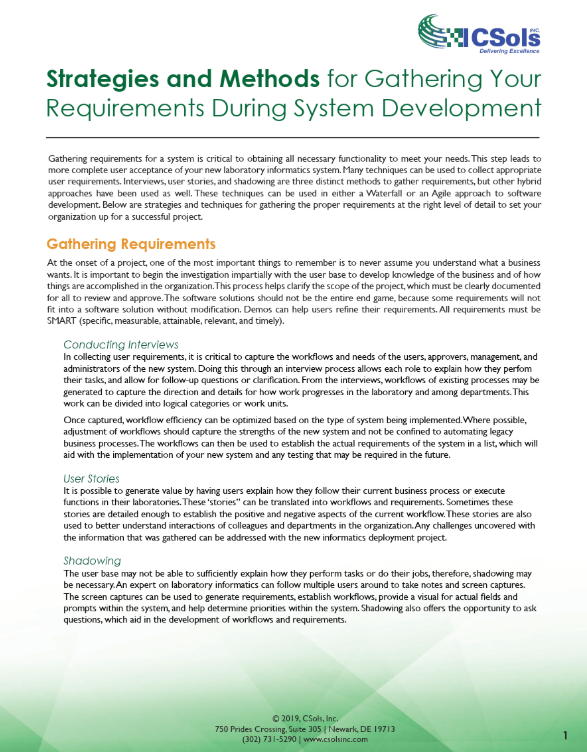
Strategies and Methods for Gathering Your Requirements During System Development

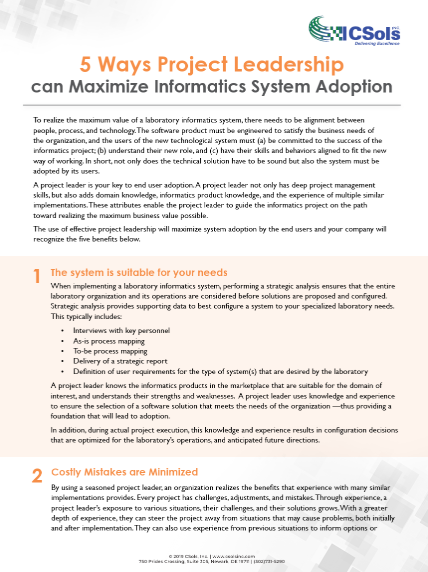
5 Ways Project Leadership Can Maximize Informatics System Adoption

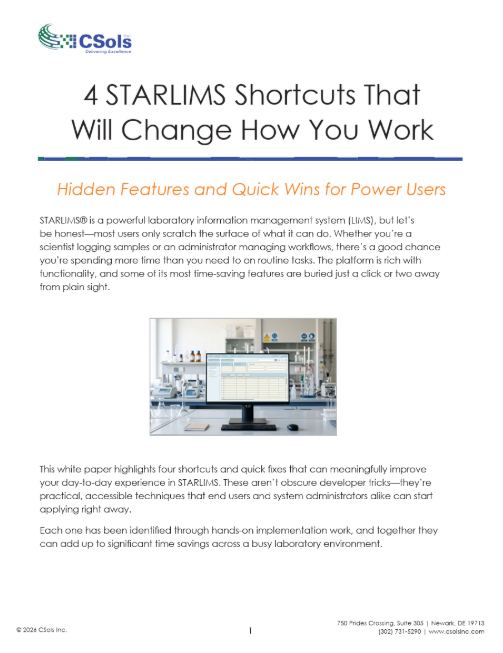
4 STARLIMS Shortcuts That Will Change How You Work

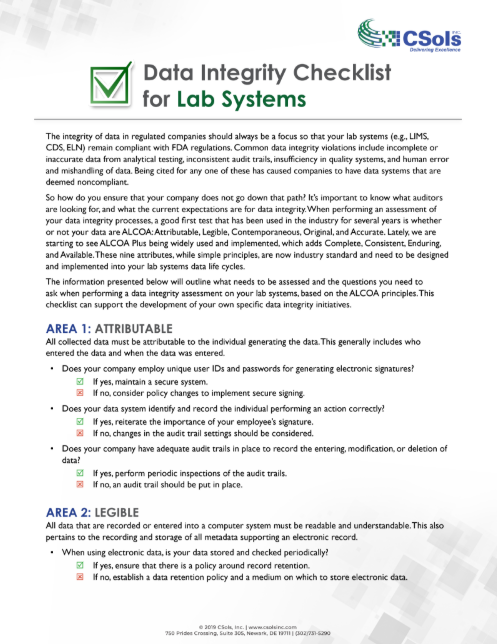
Data Integrity Checklist for Lab Systems

How to Begin Making Lab Data FAIR

Strategies and Methods for Gathering Your Requirements During System Development

Data Visualization for STARLIMS: Advanced Analytics vs. Crystal Reports

A Lab Manager’s Guide to ROI from AI

This is the CTA title

This is a placeholder heading

5 Things You Can Improve During Instrument Qualifications

eBooks

The LIMS Comparison Guide

The LIMS Comparison Guide / Navigating the LIMS Landscape

The Connected Lab: A Comprehensive Guide to Instrument Integration with Laboratory Informatics

This is an e-book title

Case Study

This is a case study title

Video

This is a video title

Resource

Heading