


Commercial laboratory informatics products historically have been disproportionately shaped by life sciences. The standard implementation playbooks, vendor roadmaps, and compliance messaging routinely assume GxP drug pipelines, clinical sample tracking or biotech workflows as the default.
Canadian specialty chemical producers operate in a completely different reality.
Whether formulating next-generation industrial coatings in Ontario, scaling battery materials in Quebec or certifying corrosion inhibitors in Alberta, these specialty chemical labs face commercial, physical and legal variables that must be addressed differently than they are in life sciences. A pharmaceutical template simply isn’t built to allow for dynamic compensation in formulation tolerance windows or raw material batch drift. Additionally, specialty chemical manufacturers often maintain multi-decade instrument lifecycles leading to legacy data transfer issues.
Delaying action on digital lab transformation today exposes chemical producers to compounding technical debt, regulatory exposure and operational drag. Here are the three inflection points Canadian specialty chemical labs must address right now, alongside practical strategies to turn these challenges into competitive advantages.
1. The Canadian Sovereign Lab Cloud Play
C-suite leaders and lab directors aggressively push cloud-first mandates for their advantages in expensing. However, moving to commercial off-the-shelf laboratory SaaS without scrutiny creates acute legal and intellectual property vulnerabilities specific to Canada.
Specialty chemical formulations, reaction kinetics, rheology profiles and synthesis workflows are trade secrets—often the sole commercial moat around a chemical manufacturer’s profit margins. When a Canadian lab adopts a standard, U.S.-parented, multi-tenant SaaS Laboratory Information Management System (LIMS), that proprietary data can fall under extraterritorial jurisdiction.
The Canadian Data Centre Illusion vs. the U.S. CLOUD Act
Many LIMS vendors reassure buyers by pointing to instances spun up in AWS Montreal or Azure Toronto. Although the physical bits reside on Canadian soil (data residency), legal custody (data sovereignty) is a different story.
Under the U.S. CLOUD Act (18 USC. §2713), any service provider subject to U.S. jurisdiction must disclose data within its "possession, custody, or control"—regardless of whether the physical servers reside inside or outside the United States. Because there is no bilateral CLOUD Act agreement in place, Canadian enterprises do not have the procedural guardrails that an executive agreement might negotiate.
The issue with a SaaS LIMS is corporate jurisdiction, not software patents. Although a U.S. software patent does not grant subpoena access to client data, a vendor incorporated in the U.S. (or owned by a U.S. corporate entity) is legally obligated to comply with U.S. federal warrants and extraterritorial disclosure orders. If a Canadian specialty chemical company uses a U.S.-incorporated LIMS/ELN vendor hosted in AWS Montreal, the U.S. government does not need a bilateral treaty or Canadian court approval to compel that vendor to disclose data. These orders frequently carry nondisclosure (gag) stipulations that prevent the vendor from ever alerting the Canadian client.
Simultaneously, Canadian domestic scrutiny has tightened. Under provincial frameworks such as Quebec’s Law 25, cross-border Transfer Impact Assessments (TIAs) are mandatory, and supply-chain liability vetting by enterprise General Counsels is at an all-time high.
Navigating the Vendor Landscape
The enterprise LIMS market is heavily dominated by U.S.-headquartered platforms. However, Canadian chemical firms evaluating alternatives have options:
- European platforms, widely adopted across European materials and chemical QC
- International and open-source engines or self-hosted, community-governed engines where the corporate data layer remains entirely customer controlled
Before you panic about possibly abandoning your current LIMS, take a step back. The real problem is not the software brand itself; it is the deployment model. When clients buy a standard, multi-tenant SaaS for which the vendor holds the administrative database credentials and encryption keys, they inherit direct U.S. CLOUD Act exposure. U.S. vendors offer technical and contractual mechanisms to insulate data from extraterritorial reach. Delivering these defensive deployment capabilities is where a vendor-neutral consultancy like CSols drives high-margin value.
Architectural and Contractual Countermeasures
Canadian enterprise labs are mitigating CLOUD Act exposure through four core strategies:
- Single-tenant virtual private cloud (VPC) with customer-managed keys: Deploy the platform in a dedicated Canadian VPC. Encrypt data at rest and in transit using Hardware Security Modules so the keys remain in Canadian possession. If a foreign warrant is served, only unreadable ciphertext is surrendered.
- Domestic Canadian infrastructure: For high-stakes synthesis and R&D pipelines, deploy on-premises at domestic facilities or host with 100% Canadian-owned infrastructure providers without U.S. parent entities.
- Decoupling sensitive formulation records: Use the commercial LIMS only for execution tasks—sample throughput, turnaround times, and pass/fail QC. Isolate intellectual property in an internal, sovereign system of record, logging projects in the cloud under anonymized tokens.
- Contractual firewalls and TIAs: Execute rigorous Data Processing Agreements stipulating that data never leaves designated Canadian availability zones, requiring vendors to contest foreign disclosure requests in court and mandating immediate customer notification wherever legally permissible.
2. Formulation Data FAIRification: The Pre-AI Diagnostic
Corporate boards and executive leadership are demanding immediate generative and predictive AI roadmaps for material science and chemical R&D. But specialty chemical formulation teams face a harsh operational reality: historical synthesis data is trapped in disconnected spreadsheets, instrument printouts, legacy ELN silos and static PDFs.
Predictive machine learning models for material properties require high-fidelity, structured data. Feeding unstandardized, fragmented historical records into commercial formulation AI algorithms results in model hallucinations, stalled projects and burned capital.
The Strategic Value of a Pre-AI Audit
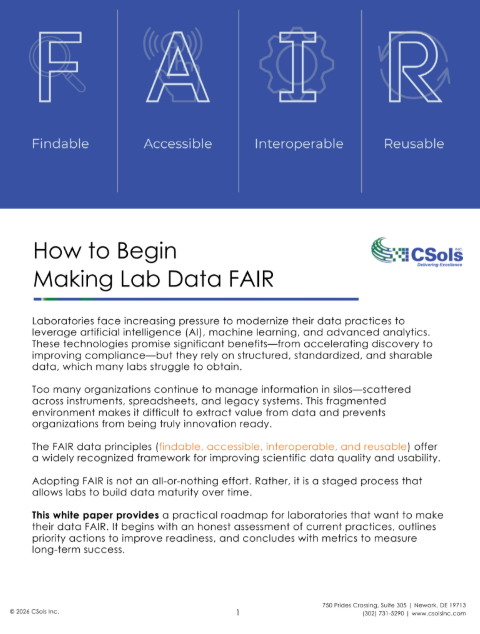
Before signing costly enterprise AI licensing agreements, forward-thinking chemical organizations are initiating structured pre-AI diagnostics centered on the FAIR data principles:
- Findable: Indexing historical formulation trials, raw material lot numbers and testing conditions under consistent metadata schemas.
- Accessible: Unlocking data from proprietary file formats, bench PC hard drives and retired software archives.
- Interoperable: Harmonizing units of measure, variable naming conventions and ambient testing conditions across product lines.
- Reusable: Validating data integrity so machine learning pipelines can reliably train on both successful formulation runs and historical formulation failures.
Positioning a phased FAIR diagnostic provides clear budget justification: it cleans the data pipeline first, de-risking any downstream AI investments.
3. Decoupling and Modernizing Legacy Lab Instruments
A typical specialty chemical QC or analytical bench relies on capital-intensive hardware. Because these analytical workhorses have physical lifespans of 15 to 20 years, chemical firms under capital expenditure constraints cannot simply replace operational instruments just because their onboard operating systems lack modern API connectivity.
The Operational Cost of Air-gapping
Retaining functional legacy instruments without digital connectivity creates severe operational bottlenecks:
- Transcription errors: Bench chemists manually type instrument values or ferry data across the lab on USB thumb drives, introducing errors and audit nonconformances.
- The Excel-as-a-LIMS trap: Chemists track formulation iterations, stability results and rheology curves in personal desktop spreadsheets. If a senior formulation chemist departs, valuable institutional knowledge leaves with them.
- Certificate of analysis (CoA) delays: Manually compiling and cross-checking instrument data to issue outbound CoAs stalls trucks and railcars at the loading dock, racking up fees.
{{cta:spreadsheets-are-not-a-database-benefits-to-using-a-lims-for-biobanking}}
Modern Integration Standards: Retrofit, Don't Replace
Instead of pursuing disruptive rip-and-replace capital projects, labs can now decouple physical hardware from legacy software using open, vendor-neutral integration architectures:
- Open consortia standards (SiLA 2 and AnIML): Modern communication protocols and standardized XML/data structures allow legacy instrument outputs to be packaged into universal formats.
- Edge/IoT bridges: Inexpensive, secured hardware bridges interface directly with serial, RS-232, or legacy OS outputs, automatically streaming raw analytical runs directly into modern LIMS and ELN environments.
- Direct MES & ERP connectivity: Automating the flow from bench instrument to enterprise platforms (such as SAP) reduces batch release turnaround from 48 hours to under 2 hours, eliminating plant storage holding bottlenecks.
Action Plan: Bridging Bench Operations and Executive Priorities
Successfully modernizing laboratory informatics requires aligning bench-level technical pain points with executive business outcomes.
- Eliminating manual spreadsheet re-entry
- Accelerating batch release times
- Direct instrument data capture
- Mitigating plant scrap and rework costs
- Centralizing synthesis recipes into ELNs
- Ensuring compliance for CEPA, WHMIS/GHS/SDS and Law 25 audits
Therefore, we recommend the following four next steps for lab leadership:
- Move beyond clinical templates: Discard pharmaceutical-centric vendor proposals. Evaluate platforms specifically against requirements for raw material variation, formulation drift, and chemical batch manufacturing needs.
- Audit data sovereignty: Review current SaaS vendor contracts. Clarify whether corporate jurisdiction exposes your trade secrets to extraterritorial discovery, and plan appropriate safeguards.
- Run a scoped discovery assessment: Instead of committing to a multi-year digital transformation out of the gate, start with a 3-to-4-week targeted workflow audit on a single pilot synthesis line or high-throughput QC lab.
- Standardize and bridge: Implement vendor-neutral middleware to connect operational analytical instruments directly to your informatics core, removing manual transcription before making major capital investments in AI.
By addressing data sovereignty, data readiness, and instrument connectivity today, Canadian specialty chemical labs can protect their core IP, expand operational throughput, and build a lasting competitive edge.
What else should Canadian specialty chemical labs consider in regard to their laboratory informatics?





Comments