

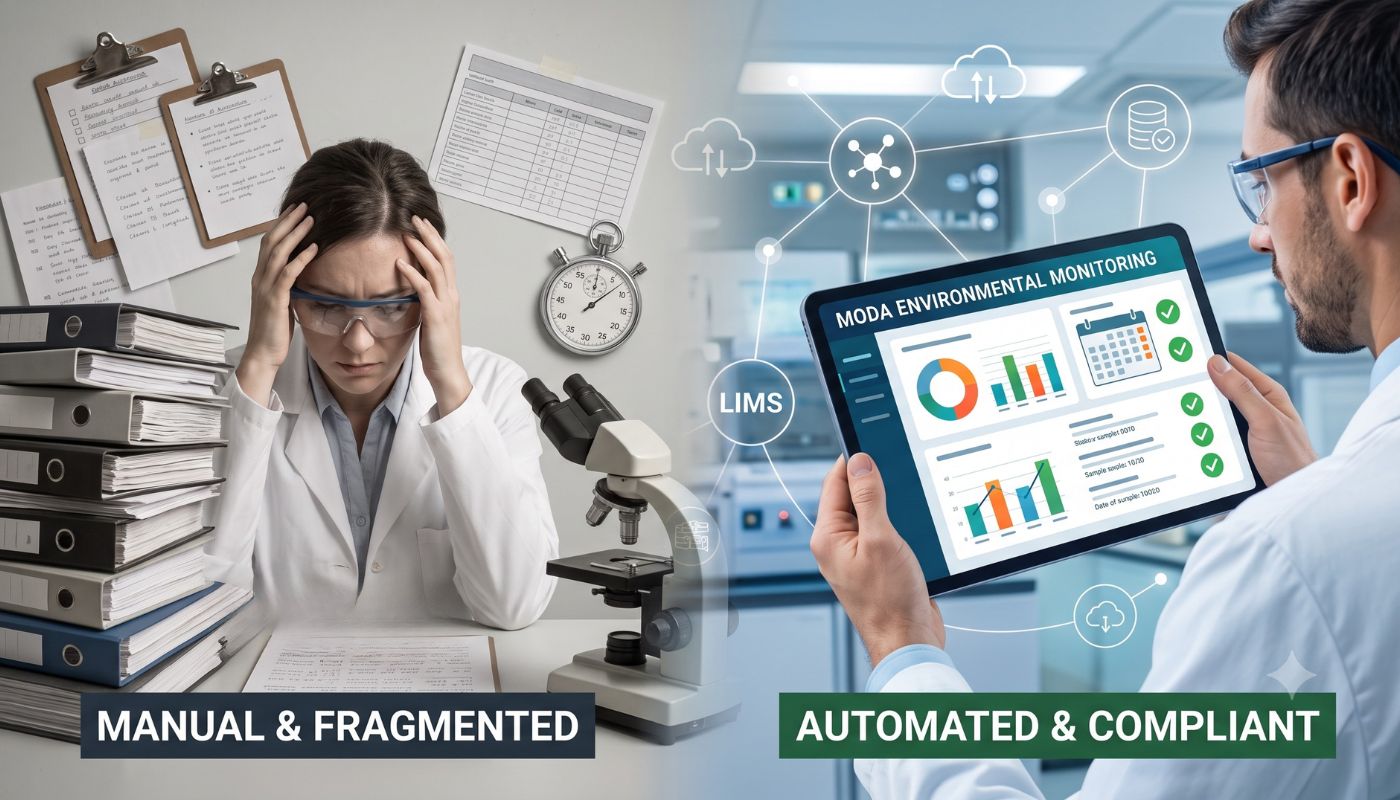
Environmental monitoring is one of those programs on which regulated and research labs rely, but few love. It sits at the heart of product quality, patient safety, and regulatory compliance, especially in industries like pharmaceuticals, biotechnology, and food and beverage. When environmental monitoring runs well, it confirms that your rooms, equipment, utilities, and people are safe and controlled. When it does not, it can delay batches, trigger investigations, and increase regulatory attention.
Traditional environmental monitoring approaches[RAS1.1] can make the work harder than it needs to be. Paper-based workflows, scattered spreadsheets, and manual transcription weigh down quality teams. Investigations drag on because data is fragmented, trending is slow, and historical context is difficult to pull together.
Enter MODA, a purpose-built environmental monitoring and microbiology informatics platform originally from Lonza and now acquired by STARLIMS. The experienced laboratory software consultants at CSols Inc. help organizations understand how MODA can fit into their broader lab informatics strategy and turn environmental monitoring into an advantage instead of a burden.
What MODA Brings to Environmental Monitoring Programs
MODA provides workflow management, data management, analytics, and compliance support for environmental monitoring and microbiology operations. Instead of clipboards and independent spreadsheets, you gain structured electronic sample scheduling, routing management, and chain of custody.
Sampling personnel know where to go, what to sample, and which methods to apply. Incubation and workflows are guided by the system. Automated calculations and rule-based evaluations help reduce transcription errors while maintaining appropriate quality review controls.
One of MODA’s key strengths is centralizing environmental monitoring data in a single, coherent view. Environmental monitoring locations, cleanroom areas, equipment, personnel, and applicable utility monitoring points can be organized within structured hierarchies. This gives the relevant teams real-time visibility about what is happening on the floor. Trending that used to require manual spreadsheets can be performed in the system, so atypical events and contamination patterns are detected faster and with more confidence.
Data integrity is another important benefit. MODA supports ALCOA+ principles with electronic audit trails, clear user attribution, and standardized methods and sampling plans. For laboratories working under FDA, Health Canada, EMA, or other regulatory expectations, this structure demonstrates that environmental monitoring is controlled, repeatable, and reliable. It also reduces the risk that incomplete or inconsistent documentation will surface during inspections or internal audits.

On top of this solid foundation, MODA provides analytics and dashboards tailored to environmental monitoring. When temperature and humidity probes or other equipment types are integrated with the system, teams can view alert and action level trends, recurring deviations, and CAPA resolutions in a single environment. This allows more meaningful risk assessments and more effective continuous improvement activities, rather than chasing isolated events without context.
The STARLIMS Acquisition and What It Means for Your Lab
MODA continues to provide specialized environmental monitoring capabilities to all labs, regardless of their LIMS platform. Its integration with STARLIMS, however, enables broader quality data management across laboratory operations. In many organizations, environmental monitoring data (except for microbial information) has been historically separated from batch release testing and broader QC lab operations. Combining MODA with STARLIMS creates an opportunity to reduce those silos and streamline how quality data moves across the lab and manufacturing network.
From an architecture standpoint, MODA is an integrated layer with STARLIMS as the enterprise backbone. This allows shared master data for products, materials, locations, and users, along with a more unified user experience across quality and manufacturing sites. Instead of juggling multiple systems with overlapping reference data and conflicting workflows, MODA aligns environmental monitoring with other critical quality processes.
For organizations that already rely on STARLIMS, this acquisition will simplify long-term platform planning and vendor management. It can also create a clearer path to scale environmental monitoring to new sites or expand capabilities without introducing additional standalone systems. Through our work as a laboratory software consulting firm and our relationship with STARLIMS, CSols can help teams think through roadmap options, integration patterns, and practical change impacts before they commit to a specific design.
Designing a Future-Ready MODA Implementation Strategy
Getting value from MODA starts long before the first configuration is built. Planning should begin with a realistic assessment of your current environmental monitoring workflows. Which steps are manual, which are duplicated, and where do delays originate? Clarifying user personas, such as samplers, microbiologists, quality reviewers, and administrators, helps ensure that the system supports how people work, not just how the process looks on paper.
Key planning steps include:
- Defining regulatory and quality objectives and how success will be measured
- Mapping integration needs with LIMS, MES, and ERP software
- Documenting current sampling plans, frequencies, and alert or action levels
- Identifying gaps in data integrity, traceability, or trending capabilities
Configuration decisions in MODA are directly tied to how your environmental monitoring program is structured. Location hierarchies, sample storage, and routing need to mirror your facilities while remaining manageable and scalable. Sampling plans and frequencies must align with risk-based strategies and qualification requirements. Standardize your microbiological methods, incubation schemes, and result interpretations and implement role-based security to ensure that both QC micro and QA teams can perform appropriately.
Data migration is often more work than it first appears. Legacy environmental monitoring data may use inconsistent naming conventions, formats, or units. Deciding which historical data to load, how much to cleanse, and how to align with new naming standards is critical to preserve trending and qualification histories. In GxP environments, validation and documentation remain foundational, from user requirements and risk assessments through IQ, OQ, and PQ. Experienced laboratory software consulting support can help streamline these activities so they are complete without being overcomplicated.

Integration, Training, and Change Management for Maximum Value
MODA rarely lives alone. Integration with other systems is where environmental monitoring data starts to support broader quality and operations decisions. For example, MODA exchanges information with STARLIMS or another LIMS to align samples, tests, and batch contexts.
Connections with MES provide production context, such as campaigns and work orders. Links with ERP support lot and material traceability, while historian or building management systems can contribute environmental condition data. APIs interface with collection instruments such as nonviable air particle counters. The interface possibilities reduce manual inputs and reduce transcription errors.
Strong training and change management initiatives are just as important to project success as technology. Effective approaches include:
- Role-based training tailored for samplers, microbiologists, QA reviewers, and administrators
- Pilot phases in high-impact areas before rolling out sitewide
- Superuser networks that provide on-the-ground support and advocate for improvements
- Feedback loops that refine workflows, templates, and dashboards over time
Organizational change management should bring together environmental monitoring process owners, quality leadership, IT, and operations. Standard operating procedures will need updates to reflect electronic workflows, data review practices, and deviation handling in MODA. Governance over configuration changes and enhancements helps keep the system aligned with the validated state and with evolving regulatory and business needs.
Turning MODA and STARLIMS Into a Strategic Quality Platform
When labs look at MODA and STARLIMS together, it is worth thinking beyond simple system replacement. This combination can support a more proactive quality culture, where environmental monitoring data is available quickly and clearly enough to influence decisions on release, cleaning strategies, and facility improvements. Faster access to meaningful environmental monitoring trends supports data-driven risk management rather than reactive firefighting.
Many organizations find it helpful to follow a phased roadmap. For instance, they might:
- Start with a focused environmental monitoring domain or a single site
- Standardize the core sampling, incubation, and result workflows
- Expand to additional rooms, equipment types, or utilities once the foundation is working well
- Gradually connect environmental data with other quality and manufacturing data streams for broader insight
Thoughtful planning, realistic configuration, disciplined integration, and strong change management turn MODA and STARLIMS from individual software tools into an integrated quality platform. With a clear strategy and the right laboratory software consulting support, environmental monitoring can shift from being a constant source of paperwork and concern to a reliable, insightful contributor to overall product quality and compliance.
Get Started With Your Project Today
If you are ready to align your lab’s technology with your scientific and business goals, our experts can help you plan the right path forward. Explore how our laboratory software consulting services can clarify requirements, reduce project risk, and accelerate implementation success. At CSols Inc., we work closely with your stakeholders to build practical, results-oriented strategies. Contact us today to talk about your specific MODA needs or next steps.
Are you using MODA in your lab for something we haven’t mentioned here? Tell us about it in the comments.




.jpg)
.png)
.png)

Comments