Recession-proofing Your Lab With Informatics and AI

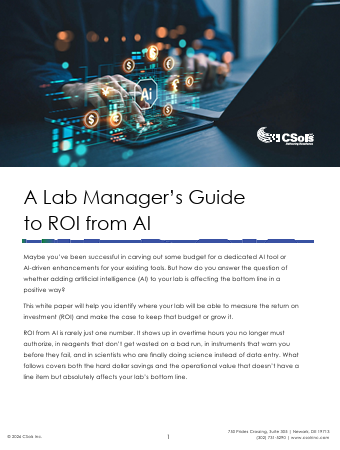
This blog post advocates for layering AI onto existing informatics solutions (LIMS, ELN, SDMS) to maximize laboratory value on a limited budget. By usng ontologies and automation, organizations can eliminate non-value-adding manual tasks, recover thousands of labor hours, and transform dark data into actionable insights without expensive system overhauls.
February 12, 2026
Recession-proofing Your Lab With Informatics and AI
TL;DR: This blog post advocates for layering AI onto existing informatics solutions (LIMS, ELN, SDMS) to maximize laboratory value on a limited budget. By usng ontologies and automation, organizations can eliminate non-value-adding manual tasks, recover thousands of labor hours, and transform dark data into actionable insights without expensive system overhauls.

Maximizing the value of existing informatics solutions (LIMS, ELN, or SDMS) on a limited budget is something that every lab thinks about. To be effective, such strategies require a layering approach rather than a replacement mindset. Instead of expensive system overhauls, organizations can use AI to bridge gaps in data quality, automate tedious manual steps, and extract insights that were previously hidden in dark data.

Although the economics of every organization vary, any opportunity to improve efficiency and reduce costs should be seized to gain a competitive edge. This blog post provides insights on how to use AI strategically in your lab to get the most from your informatics systems.

Why Optimization Is Better Than Cost Reduction

When a CFO asks to reduce lab expenses, they are often looking at the wrong lever (headcount). Although headcount reduction provides a quick optical win on a balance sheet, it almost always increases turnaround time and triggers a cycle of attrition and error that costs more than the salary saved:

In contrast, layering AI and digital workflows onto existing staff and systems produces dramatic, measurable ROI:

The real opportunity lies in releasing the potential of your existing systems. By using AI to eliminate non-value-adding steps—like manual data entry or hunting for legacy results—you transform the lab from a bottleneck into a cash-flow accelerator. Organizations that focus on enablement with an AI tool see the results in their bottom line:

  • Accelerated Revenue: Faster batch release cycles.
  • Reduced Risk: Fewer retests through improved first-time-right rates.
  • Predictability: Supply chain reliability that builds customer trust.

We suggest focusing on the following three strategic areas of AI enablement.

1.Enhancing AI Data Accessibility: The Power of Common Language

When budgets are tight, the most effective AI enablement strategies focus on optimization and integration to improve data accessibility rather than building from scratch. At its heart, an AI tool takes the data it is fed and produces accurate outputs, such as reports on trends, batch releases, or trial results. To be accurate, the AI tool needs access to complete and well-structured data that does not exist in a silo.

However, your AI also needs context for that data. This is where ontologies come in—the digital dictionaries that define the relationships between your data points. AI cannot guess that hydrochloric acid in your LIMS is the same as HCl in your chromatography data system (CDS) or muriatic acid in your inventory tracking system. By mapping your systems to a standard ontology, you create a Rosetta Stone that allows AI to query across systems accurately. 

Investing in an ontology is often cheaper than a software overhaul. Once your ontology is complete, your AI can help with:

  • Automated Metadata Tagging: Scan unstructured files (PDFs, instrument exports) within a scientific data management system (SDMS) or platform and automatically apply searchable metadata tags. This saves researchers hours of manual searching.
  • Natural Language Querying: A scientist can ask a chatbot, "Show me all stability tests for Batch X in 2024," and have the AI pull that from the LIMS, eliminating the need for complex SQL queries or specialized training.
  • Legacy Data Normalization: AI can translate between different electronic lab notebook (ELN) versions or disparate systems across departments, harmonizing units and naming conventions without a manual migration project.

2.Operational Efficiency and Automation with AI

Removing the friction of daily lab work can be a huge revenue engine. If your average scientist spends 10 hours a week manually entering and processing data, and an AI tool working with a high-value system can save that scientist 15 minutes a day, you can give that scientist 62.5 extra hours every year. AI-driven automation can recover thousands of hours per year in a large organization, essentially gifting the lab the equivalent of dozens of full-time employees.

  • Smart Documentation Assistants: AI can prepopulate ELN entries by pulling parameters directly from instrument logs, reducing transcription errors and "re-work" costs.
  • Predictive Maintenance: By analyzing instrument performance data stored in the LIMS, AI can alert the lab to a potential failure before it happens, preventing costly downtime and lost samples.
  • Inventory & Reagent Optimization: Use machine learning to analyze usage patterns and predict when stocks will run low, ensuring you never over-order or face a stockout during a critical trial.

3.Maximizing ROI Through AI-powered Analytics

Budget-conscious organizations know that their dark data can quickly become an asset. There are many ways to leverage dark data with AI to improve your return on investment (ROI).

  • Identifying Invisible Trends: AI can run cross analyses on years of historical ELN data to find correlations (e.g., why certain environmental conditions lead to higher yields) that a human would never spot.
  • Accelerated Batch Release: AI can scan batch records against established parameters and flag only the anomalies for human review (review by exception), significantly shortening the release cycle.
  • Protocol Optimization: Before running a physical experiment, use historical data to simulate outcomes in a dry lab. This reduces the number of wet lab cycles needed, saving expensive reagents and labor.

What About Data Integrity with AI?

Data integrity is the foundation of any AI strategy. AI is only as good as the data it accesses. Budget-conscious labs may want to start with a small pilot on a single high-friction process to prove ROI quickly without having to produce massive amounts of well-structured data. If you want to know more about data integrity and AI, the U.S. Food and Drug Administration has published guidance on Considerations for the Use of Artificial Intelligence to Support Regulatory Decision Making for Drug and Biological Products. 


Want to know more about how adding AI capabilities to your lab informatics could help to recession-proof your lab? We’re here to help.

Comments

Leave a reply. Your email address will not be published. Required fields are marked *
This site uses Akismet to reduce spam. Learn how your comment data is processed.
Thank you! Your submission has been received!
Oops! Something went wrong while submitting the form.

Recession-proofing Your Lab With Informatics and AI

This blog post advocates for layering AI onto existing informatics solutions (LIMS, ELN, SDMS) to maximize laboratory value on a limited budget. By usng ontologies and automation, organizations can eliminate non-value-adding manual tasks, recover thousands of labor hours, and transform dark data into actionable insights without expensive system overhauls.

This blog post advocates for layering AI onto existing informatics solutions (LIMS, ELN, SDMS) to maximize laboratory value on a limited budget. By usng ontologies and automation, organizations can eliminate non-value-adding manual tasks, recover thousands of labor hours, and transform dark data into actionable insights without expensive system overhauls.

TL;DR: This blog post advocates for layering AI onto existing informatics solutions (LIMS, ELN, SDMS) to maximize laboratory value on a limited budget. By usng ontologies and automation, organizations can eliminate non-value-adding manual tasks, recover thousands of labor hours, and transform dark data into actionable insights without expensive system overhauls.

Maximizing the value of existing informatics solutions (LIMS, ELN, or SDMS) on a limited budget is something that every lab thinks about. To be effective, such strategies require a layering approach rather than a replacement mindset. Instead of expensive system overhauls, organizations can use AI to bridge gaps in data quality, automate tedious manual steps, and extract insights that were previously hidden in dark data.

Although the economics of every organization vary, any opportunity to improve efficiency and reduce costs should be seized to gain a competitive edge. This blog post provides insights on how to use AI strategically in your lab to get the most from your informatics systems.

Why Optimization Is Better Than Cost Reduction

When a CFO asks to reduce lab expenses, they are often looking at the wrong lever (headcount). Although headcount reduction provides a quick optical win on a balance sheet, it almost always increases turnaround time and triggers a cycle of attrition and error that costs more than the salary saved:

In contrast, layering AI and digital workflows onto existing staff and systems produces dramatic, measurable ROI:

The real opportunity lies in releasing the potential of your existing systems. By using AI to eliminate non-value-adding steps—like manual data entry or hunting for legacy results—you transform the lab from a bottleneck into a cash-flow accelerator. Organizations that focus on enablement with an AI tool see the results in their bottom line:

  • Accelerated Revenue: Faster batch release cycles.
  • Reduced Risk: Fewer retests through improved first-time-right rates.
  • Predictability: Supply chain reliability that builds customer trust.

We suggest focusing on the following three strategic areas of AI enablement.

1.Enhancing AI Data Accessibility: The Power of Common Language

When budgets are tight, the most effective AI enablement strategies focus on optimization and integration to improve data accessibility rather than building from scratch. At its heart, an AI tool takes the data it is fed and produces accurate outputs, such as reports on trends, batch releases, or trial results. To be accurate, the AI tool needs access to complete and well-structured data that does not exist in a silo.

However, your AI also needs context for that data. This is where ontologies come in—the digital dictionaries that define the relationships between your data points. AI cannot guess that hydrochloric acid in your LIMS is the same as HCl in your chromatography data system (CDS) or muriatic acid in your inventory tracking system. By mapping your systems to a standard ontology, you create a Rosetta Stone that allows AI to query across systems accurately. 

Investing in an ontology is often cheaper than a software overhaul. Once your ontology is complete, your AI can help with:

  • Automated Metadata Tagging: Scan unstructured files (PDFs, instrument exports) within a scientific data management system (SDMS) or platform and automatically apply searchable metadata tags. This saves researchers hours of manual searching.
  • Natural Language Querying: A scientist can ask a chatbot, "Show me all stability tests for Batch X in 2024," and have the AI pull that from the LIMS, eliminating the need for complex SQL queries or specialized training.
  • Legacy Data Normalization: AI can translate between different electronic lab notebook (ELN) versions or disparate systems across departments, harmonizing units and naming conventions without a manual migration project.

2.Operational Efficiency and Automation with AI

Removing the friction of daily lab work can be a huge revenue engine. If your average scientist spends 10 hours a week manually entering and processing data, and an AI tool working with a high-value system can save that scientist 15 minutes a day, you can give that scientist 62.5 extra hours every year. AI-driven automation can recover thousands of hours per year in a large organization, essentially gifting the lab the equivalent of dozens of full-time employees.

  • Smart Documentation Assistants: AI can prepopulate ELN entries by pulling parameters directly from instrument logs, reducing transcription errors and "re-work" costs.
  • Predictive Maintenance: By analyzing instrument performance data stored in the LIMS, AI can alert the lab to a potential failure before it happens, preventing costly downtime and lost samples.
  • Inventory & Reagent Optimization: Use machine learning to analyze usage patterns and predict when stocks will run low, ensuring you never over-order or face a stockout during a critical trial.

3.Maximizing ROI Through AI-powered Analytics

Budget-conscious organizations know that their dark data can quickly become an asset. There are many ways to leverage dark data with AI to improve your return on investment (ROI).

  • Identifying Invisible Trends: AI can run cross analyses on years of historical ELN data to find correlations (e.g., why certain environmental conditions lead to higher yields) that a human would never spot.
  • Accelerated Batch Release: AI can scan batch records against established parameters and flag only the anomalies for human review (review by exception), significantly shortening the release cycle.
  • Protocol Optimization: Before running a physical experiment, use historical data to simulate outcomes in a dry lab. This reduces the number of wet lab cycles needed, saving expensive reagents and labor.

What About Data Integrity with AI?

Data integrity is the foundation of any AI strategy. AI is only as good as the data it accesses. Budget-conscious labs may want to start with a small pilot on a single high-friction process to prove ROI quickly without having to produce massive amounts of well-structured data. If you want to know more about data integrity and AI, the U.S. Food and Drug Administration has published guidance on Considerations for the Use of Artificial Intelligence to Support Regulatory Decision Making for Drug and Biological Products. 


Want to know more about how adding AI capabilities to your lab informatics could help to recession-proof your lab? We’re here to help.

Start Date
End Date
Event Location