26 Questions to Demand More From Your Lab Data in 2026

A strategic roadmap for 2026 lab data readiness, covering AI governance, FAIR data, automation, and turning labs into scalable engines.
January 15, 2026
TL;DR: This blog post provides a strategic roadmap for 2026 laboratory data readiness, addressing critical themes such as agentic AI governance, FAIR data principles, and Lab 4.0 automation to help organizations transition from manual cost centers to scalable, data-driven revenue engines. 

In this blog post, we provide answers to some of the questions you should be asking to make 2026 a year of data readiness. Because it’s a long list, we’ve divided the questions into thematic areas so you can start with the ones that matter the most to you.

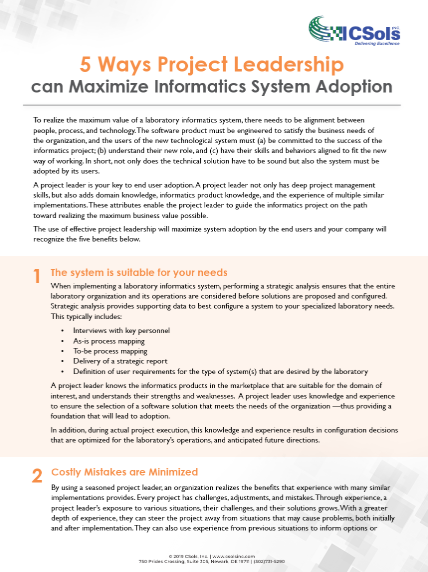
Strategy, Budget, and ROI

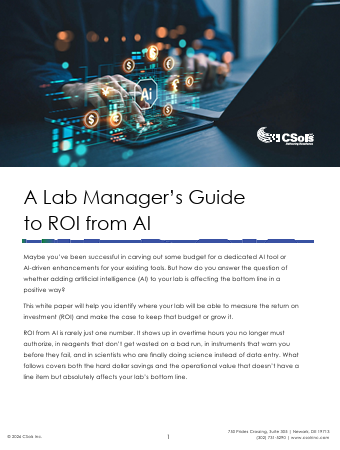
The laboratory is no longer a cost center; it is an engine for data-driven revenue. As we enter 2026, the gap is widening between labs that only fund basic upkeep and labs that innovate and treat informatics as a scalable asset. These questions focus on how to align your financial investments with long-term growth and prove the tangible dollar value of your digital transformation efforts.

1. Is our 2026 budget for innovation or just maintenance?

A healthy 2026 budget should allocate at least 30% to transformative tech like data modernization, AI agents, or system integration (including robotics). If you are only funding upkeep, your cost-per-test will eventually exceed that of competitors who are automating their overhead. Innovation is the only way to scale without a linear increase in headcount.

💸
Total cost of ownership

Maintaining a LIMS that’s 10+ years old costs ~25% more annually than a modern SaaS solution.

2. How do we measure the dollar value of our digital transformation?


Move from viewing your ELN or LIMS as a cost to a proven investment in speed and error reduction. The value of investing in digital transformation is measured by the reduction in time-to-result, the decrease in manual rework rates, and the ability to scale volume without adding headcount. Shift your KPIs from system uptime to revenue enabled per scientist.

3. Is our lab data management platform a competitive advantage or a bottleneck?


If your system requires manual workarounds or takes months to configure for a new assay, that is a bottleneck. If that’s you, 2026 is the year to stop patching and start rebuilding. An advantageous LIMS or ELN system accelerates experimental design and data release.

4. Why did our last project go over budget?


Most overruns stem from scope creep caused by a lack of clear initial requirements or poor data mapping. Identifying the root cause—be it vendor lag or internal resistance—allows you to build more realistic project timelines for the future and prevent reoccurrences.

5. Is our vendor’s roadmap aligned with our 5-year plan?


Review your vendor's commitment to open APIs and cloud-native architecture; if they aren't prioritizing interoperability, they will leave you stranded. You need a partner who evolves as fast as the science, not one that forces you into legacy stagnation. Ensure your partners are moving toward the same future as you are. 

AI and the New Frontiers of Lab Data Management

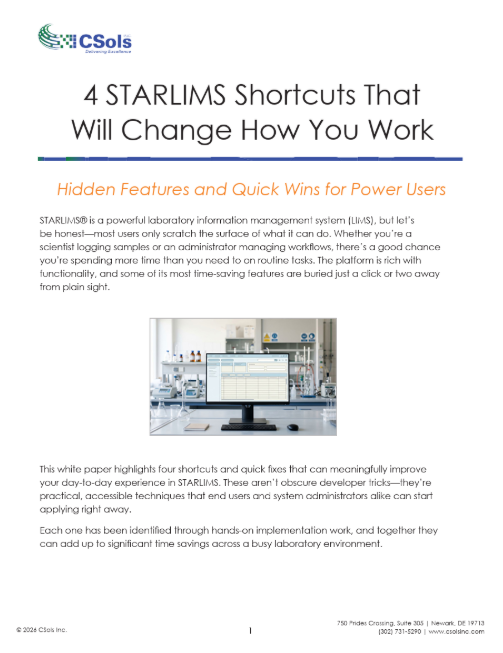
We have moved past the hype of generative AI and into the era of agentic AI, where models perform complex, multistep scientific workflows. To thrive in this environment, leadership must define the boundaries of autonomous decision making and establish rigorous new validation standards. These questions address the practicalities of governing evolving intelligence while maintaining the highest levels of scientific trust.

6. Are we using AI to solve specific bottlenecks or just as a buzzword? 

AI should be deployed for high-volume tasks like automated peak integration or predictive maintenance of liquid handlers. Avoid general AI projects without a defined ROI, as they consume resources without improving lab throughput.

7. Where must a human signature remain mandatory vs. where can AI act as the final verifier? 

Human oversight is mandatory for high-risk clinical interpretations and final regulatory submissions. However, AI can now act as the primary reviewer for routine QC checks, flagging only the anomalies for human intervention.

8. How do we validate an evolving AI model without a month-long revalidation cycle? 

Implementation of computer software assurance (CSA) principles allows for continuous performance monitoring rather than static revalidation. By using a locked model for production while shadowing it with a learning version, you can verify improvements in real time.

9. How can we participate in collective intelligence without exposing proprietary data? 

Use federated learning or differential privacy frameworks to train models on shared industry datasets. This allows your lab to benefit from global trends and big data insights while the raw, sensitive data never leaves your secure local environment.

10. How do we merge disparate data (genomics, wearables, proteomics) into a digital twin of a patient? 

Use unified data schemas to map genomics, proteomics, and wearable data into a single longitudinal record. This digital twin allows for in-silico modeling of patient responses, significantly speeding up personalized medicine workflows.

Data Integrity and Governance

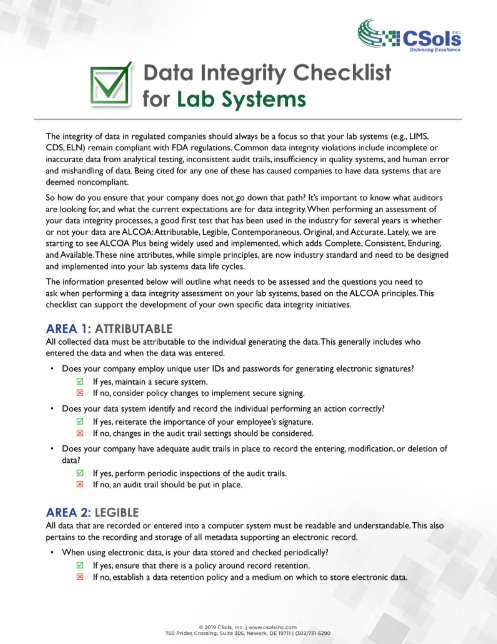
Data is the most expensive and permanent asset your laboratory produces, yet it is often locked in formats that make it unusable for future discovery. Robust governance ensures that every result is findable, accessible, and protected from the risks of data silos. This section examines how to build a foundation of high-quality, FAIR data that will remain valuable for decades to come.

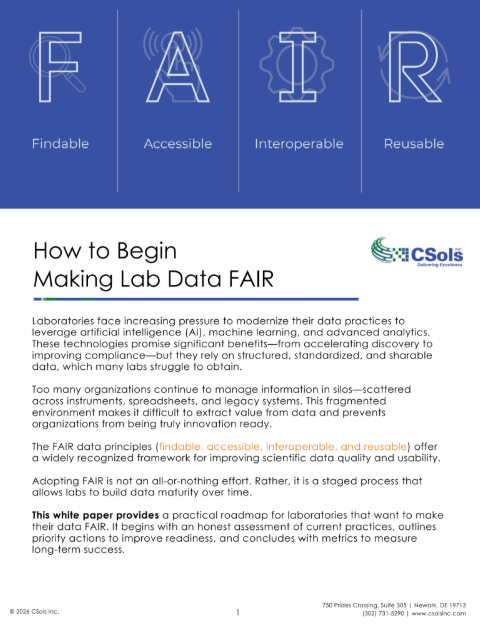
11. Is our data FAIR (Findable, Accessible, Interoperable, Reusable)? 

Data is FAIR if it can be queried across the organization without manual intervention or specialized data cleaning. In 2026, non-FAIR data is a liability because it cannot be fed into the AI models that drive discovery.

12. Do we own our data in open formats, or is it locked in vendor-proprietary silos?

 True ownership of your lab data means being able to extract it in a desired format at any time without paying vendor fees. If your data is trapped, you lose the ability to use modern third-party analytics and visualization tools.

13. How many spreadsheets are running critical calculations?

Every spreadsheet performing a calculation outside a LIMS/ELN is a hidden data integrity risk. Transitioning these to low-code modules within your validated system ensures calculations are version-controlled and auditable.
14. Do we have a formal data governance committee, or is everyone (no one) responsible?

Data governance requires a centralized committee to define standards for metadata, naming conventions, and retention policies. Without this, making everyone responsible usually results in inconsistent data that is impossible to aggregate.

15. Is our metadata descriptive enough for a scientist in 2036 to understand?

Metadata must include why and how (e.g., instrument settings, ambient temperature), not just what. Thinking a decade ahead ensures your current R&D remains a valuable, searchable asset for future scientists.

🗃️
Data durability

Digital data from 20 years ago is becoming unreadable. Format-proofing is now vital.

16. How much dark data are we paying to store but never using?

Dark data (unindexed raw files) accounts for massive storage costs and creates a wider attack surface for cyber threats. Implement automated data tiering to archive or delete nonessential data while indexing high-value assets for searchability.

Automation and the Smart Lab

The smart lab (Lab 4.0) is defined by the seamless, bidirectional flow of information between physical instruments and digital platforms. By eliminating manual touchpoints and creating digital twins of physical operations, labs can scale their output without a linear increase in headcount. These questions evaluate your progress toward a frictionless, plug-and-play environment where automation serves the scientist, not the other way around.

17. Can we achieve a plug-and-play lab using standards like Laboratory and Analytical Device Standard (LADS)? 

The adoption of LADS allows for a universal translator between instruments and software. This eliminates the need for expensive custom drivers every time you buy a new piece of hardware.

18. Are instruments integrated, or are we still using a sneakernet?

 Manual data transfers via USB or paper printouts are the primary source of transcription errors and 483 warning letters. Direct API or IoT integration ensures data flows directly from the source to the system of record, maintaining a pristine chain of custody.

19. How many manual transcriptions can we eliminate in the next 6 months?

Identify every instance in which a scientist reads a screen and types into another; these are your targets. Automating just five of these major touchpoints can save hundreds of labor hours annually.

20. Can we use a digital twin of our lab layout to predict capacity bottlenecks?

By modeling your lab's physical workflow digitally, you can run what-if scenarios to see how new projects will impact equipment availability. This prevents clogging the lab during peak periods and optimizes instrument use.

People, Culture, and Risk

Technology is only as effective as the people who operate it and the culture that governs its use. As laboratory roles shift from manual benchwork to data verification and oversight, the workforce requires a new set of hybrid skills and a heightened awareness of lab-specific security threats. This final section focuses on the human element: fostering a culture of accuracy and protecting your staff from the sophisticated risks of a digital-first world.

21. Are scientists spending more time at the bench or at the keyboard?

 If your scientists spend >30% of their day on data entry, your informatics strategy is failing. In 2026, technology (voice-to-text, AR, and automated syncing) should return the scientist to the science of the experiment.

22. When was the last time we asked bench scientists about their software pain?

 Shadow your staff for a day to see where they are fighting the lab data management software. User adoption is the single biggest factor in ROI; software that is a burden will lead to noncompliance and staff turnover.

23. How do we retrain wet lab scientists in Python/R without losing biological expertise? 

Provide data literacy workshops that focus on data interpretation rather than just coding. The goal is to create bilingual scientists who understand the biological context but can also verify the outputs of an AI algorithm in a dry lab.

24. Are we validating based on risk (CSA) or just checking boxes?

Transitioning to Computer Software Assurance (CSA) allows you to focus 80% of your testing effort on the 20% of the system that affects patient safety or product quality. This modern approach reduces validation time by up to 50% while increasing data security.
25. Does our culture reward data accuracy over positive results? 

A healthy lab culture celebrates the discovery of an error as much as a successful experiment. If staff feel pressured to produce clean data, they may inadvertently (or intentionally) bypass controls to show success.

26. Is our cyber-training specific to lab-targeted attacks or just generic?

Generic phishing training isn't enough; your team needs to recognize IP theft tactics and social engineering aimed at laboratory access. Lab-specific cybersecurity is a rapidly maturing field driven by the fact that traditional IT training fails to protect the specialized hardware found in a lab.

At CSols, we don't just ask these questions; we help you implement the answers. From LIMS selection to AI-readiness audits, we are your partner in lab excellence.


Do you have questions that weren’t addressed here? Let us know in the comments.

Comments

Leave a reply. Your email address will not be published. Required fields are marked *
This site uses Akismet to reduce spam. Learn how your comment data is processed.
Thank you! Your submission has been received!
Oops! Something went wrong while submitting the form.

26 Questions to Demand More From Your Lab Data in 2026

A strategic roadmap for 2026 lab data readiness, covering AI governance, FAIR data, automation, and turning labs into scalable engines.

A strategic roadmap for 2026 lab data readiness, covering AI governance, FAIR data, automation, and turning labs into scalable engines.

TL;DR: This blog post provides a strategic roadmap for 2026 laboratory data readiness, addressing critical themes such as agentic AI governance, FAIR data principles, and Lab 4.0 automation to help organizations transition from manual cost centers to scalable, data-driven revenue engines. 

In this blog post, we provide answers to some of the questions you should be asking to make 2026 a year of data readiness. Because it’s a long list, we’ve divided the questions into thematic areas so you can start with the ones that matter the most to you.

Strategy, Budget, and ROI

The laboratory is no longer a cost center; it is an engine for data-driven revenue. As we enter 2026, the gap is widening between labs that only fund basic upkeep and labs that innovate and treat informatics as a scalable asset. These questions focus on how to align your financial investments with long-term growth and prove the tangible dollar value of your digital transformation efforts.

1. Is our 2026 budget for innovation or just maintenance?

A healthy 2026 budget should allocate at least 30% to transformative tech like data modernization, AI agents, or system integration (including robotics). If you are only funding upkeep, your cost-per-test will eventually exceed that of competitors who are automating their overhead. Innovation is the only way to scale without a linear increase in headcount.

💸
Total cost of ownership

Maintaining a LIMS that’s 10+ years old costs ~25% more annually than a modern SaaS solution.

2. How do we measure the dollar value of our digital transformation?


Move from viewing your ELN or LIMS as a cost to a proven investment in speed and error reduction. The value of investing in digital transformation is measured by the reduction in time-to-result, the decrease in manual rework rates, and the ability to scale volume without adding headcount. Shift your KPIs from system uptime to revenue enabled per scientist.

3. Is our lab data management platform a competitive advantage or a bottleneck?


If your system requires manual workarounds or takes months to configure for a new assay, that is a bottleneck. If that’s you, 2026 is the year to stop patching and start rebuilding. An advantageous LIMS or ELN system accelerates experimental design and data release.

4. Why did our last project go over budget?


Most overruns stem from scope creep caused by a lack of clear initial requirements or poor data mapping. Identifying the root cause—be it vendor lag or internal resistance—allows you to build more realistic project timelines for the future and prevent reoccurrences.

5. Is our vendor’s roadmap aligned with our 5-year plan?


Review your vendor's commitment to open APIs and cloud-native architecture; if they aren't prioritizing interoperability, they will leave you stranded. You need a partner who evolves as fast as the science, not one that forces you into legacy stagnation. Ensure your partners are moving toward the same future as you are. 

AI and the New Frontiers of Lab Data Management

We have moved past the hype of generative AI and into the era of agentic AI, where models perform complex, multistep scientific workflows. To thrive in this environment, leadership must define the boundaries of autonomous decision making and establish rigorous new validation standards. These questions address the practicalities of governing evolving intelligence while maintaining the highest levels of scientific trust.

6. Are we using AI to solve specific bottlenecks or just as a buzzword? 

AI should be deployed for high-volume tasks like automated peak integration or predictive maintenance of liquid handlers. Avoid general AI projects without a defined ROI, as they consume resources without improving lab throughput.

7. Where must a human signature remain mandatory vs. where can AI act as the final verifier? 

Human oversight is mandatory for high-risk clinical interpretations and final regulatory submissions. However, AI can now act as the primary reviewer for routine QC checks, flagging only the anomalies for human intervention.

8. How do we validate an evolving AI model without a month-long revalidation cycle? 

Implementation of computer software assurance (CSA) principles allows for continuous performance monitoring rather than static revalidation. By using a locked model for production while shadowing it with a learning version, you can verify improvements in real time.

9. How can we participate in collective intelligence without exposing proprietary data? 

Use federated learning or differential privacy frameworks to train models on shared industry datasets. This allows your lab to benefit from global trends and big data insights while the raw, sensitive data never leaves your secure local environment.

10. How do we merge disparate data (genomics, wearables, proteomics) into a digital twin of a patient? 

Use unified data schemas to map genomics, proteomics, and wearable data into a single longitudinal record. This digital twin allows for in-silico modeling of patient responses, significantly speeding up personalized medicine workflows.

Data Integrity and Governance

Data is the most expensive and permanent asset your laboratory produces, yet it is often locked in formats that make it unusable for future discovery. Robust governance ensures that every result is findable, accessible, and protected from the risks of data silos. This section examines how to build a foundation of high-quality, FAIR data that will remain valuable for decades to come.

11. Is our data FAIR (Findable, Accessible, Interoperable, Reusable)? 

Data is FAIR if it can be queried across the organization without manual intervention or specialized data cleaning. In 2026, non-FAIR data is a liability because it cannot be fed into the AI models that drive discovery.

12. Do we own our data in open formats, or is it locked in vendor-proprietary silos?

 True ownership of your lab data means being able to extract it in a desired format at any time without paying vendor fees. If your data is trapped, you lose the ability to use modern third-party analytics and visualization tools.

13. How many spreadsheets are running critical calculations?

Every spreadsheet performing a calculation outside a LIMS/ELN is a hidden data integrity risk. Transitioning these to low-code modules within your validated system ensures calculations are version-controlled and auditable.

14. Do we have a formal data governance committee, or is everyone (no one) responsible?

Data governance requires a centralized committee to define standards for metadata, naming conventions, and retention policies. Without this, making everyone responsible usually results in inconsistent data that is impossible to aggregate.

15. Is our metadata descriptive enough for a scientist in 2036 to understand?

Metadata must include why and how (e.g., instrument settings, ambient temperature), not just what. Thinking a decade ahead ensures your current R&D remains a valuable, searchable asset for future scientists.

🗃️
Data durability

Digital data from 20 years ago is becoming unreadable. Format-proofing is now vital.

16. How much dark data are we paying to store but never using?

Dark data (unindexed raw files) accounts for massive storage costs and creates a wider attack surface for cyber threats. Implement automated data tiering to archive or delete nonessential data while indexing high-value assets for searchability.

Automation and the Smart Lab

The smart lab (Lab 4.0) is defined by the seamless, bidirectional flow of information between physical instruments and digital platforms. By eliminating manual touchpoints and creating digital twins of physical operations, labs can scale their output without a linear increase in headcount. These questions evaluate your progress toward a frictionless, plug-and-play environment where automation serves the scientist, not the other way around.

17. Can we achieve a plug-and-play lab using standards like Laboratory and Analytical Device Standard (LADS)? 

The adoption of LADS allows for a universal translator between instruments and software. This eliminates the need for expensive custom drivers every time you buy a new piece of hardware.

18. Are instruments integrated, or are we still using a sneakernet?

 Manual data transfers via USB or paper printouts are the primary source of transcription errors and 483 warning letters. Direct API or IoT integration ensures data flows directly from the source to the system of record, maintaining a pristine chain of custody.

19. How many manual transcriptions can we eliminate in the next 6 months?

Identify every instance in which a scientist reads a screen and types into another; these are your targets. Automating just five of these major touchpoints can save hundreds of labor hours annually.

20. Can we use a digital twin of our lab layout to predict capacity bottlenecks?

By modeling your lab's physical workflow digitally, you can run what-if scenarios to see how new projects will impact equipment availability. This prevents clogging the lab during peak periods and optimizes instrument use.

People, Culture, and Risk

Technology is only as effective as the people who operate it and the culture that governs its use. As laboratory roles shift from manual benchwork to data verification and oversight, the workforce requires a new set of hybrid skills and a heightened awareness of lab-specific security threats. This final section focuses on the human element: fostering a culture of accuracy and protecting your staff from the sophisticated risks of a digital-first world.

21. Are scientists spending more time at the bench or at the keyboard?

 If your scientists spend >30% of their day on data entry, your informatics strategy is failing. In 2026, technology (voice-to-text, AR, and automated syncing) should return the scientist to the science of the experiment.

22. When was the last time we asked bench scientists about their software pain?

 Shadow your staff for a day to see where they are fighting the lab data management software. User adoption is the single biggest factor in ROI; software that is a burden will lead to noncompliance and staff turnover.

23. How do we retrain wet lab scientists in Python/R without losing biological expertise? 

Provide data literacy workshops that focus on data interpretation rather than just coding. The goal is to create bilingual scientists who understand the biological context but can also verify the outputs of an AI algorithm in a dry lab.

24. Are we validating based on risk (CSA) or just checking boxes?

Transitioning to Computer Software Assurance (CSA) allows you to focus 80% of your testing effort on the 20% of the system that affects patient safety or product quality. This modern approach reduces validation time by up to 50% while increasing data security.

25. Does our culture reward data accuracy over positive results? 

A healthy lab culture celebrates the discovery of an error as much as a successful experiment. If staff feel pressured to produce clean data, they may inadvertently (or intentionally) bypass controls to show success.

26. Is our cyber-training specific to lab-targeted attacks or just generic?

Generic phishing training isn't enough; your team needs to recognize IP theft tactics and social engineering aimed at laboratory access. Lab-specific cybersecurity is a rapidly maturing field driven by the fact that traditional IT training fails to protect the specialized hardware found in a lab.

At CSols, we don't just ask these questions; we help you implement the answers. From LIMS selection to AI-readiness audits, we are your partner in lab excellence.


Do you have questions that weren’t addressed here? Let us know in the comments.
Start Date
End Date
Event Location