


Agaram Technologies has been advancing laboratory informatics for over 27 years, serving customers across 30+ countries with reliable, enterprise-class solutions that create a cohesive laboratory ecosystem Agaram offers a range of feature-rich, flexible digital solutions such as Qualis LIMS, Logilab ELN, and Logilab SDMS that help laboratories streamline data management, achieve regulatory compliance, stay audit ready, and optimize overall operational performance.
Opinions expressed by CSols Inc. contributors are their own.
Some of you may be lucky enough to know that “new lab” smell. But setting up a new laboratory goes beyond designing physical space and installing instruments. It requires a clear definition of how research workflows will function from day one. Every experiment, sample, and data point follows a process. If that process is not structured early, inefficiencies can quickly become embedded in daily operations.
This is where lab informatics solutions play a critical role. They provide the digital framework that supports how work is executed, documented, and managed across the lab.
Before selecting any system, the priority should be workflow design. Laboratories need to define how and where research activities are initiated, how samples are registered and processed, what approvals are required, and how data is captured and reported. Informatics platforms should support these workflows in a structured yet flexible way, without adding unnecessary complexity.
Lab Automation Starts with Research Workflows
A well-defined research workflow establishes the foundation for efficient laboratory operations. It outlines how work progresses from experiment planning to execution, review, and reporting.
Each stage should be clearly mapped, including responsibilities, checkpoints, and data generation points. This ensures that all activities follow a consistent and traceable path.
Lab informatics solutions such as ELN and LIMS play a central role in structuring and documenting these workflows. They allow laboratories to standardize processes, reduce variability, and maintain consistency across different teams and projects.
Working within a digital environment eliminates reliance on disconnected spreadsheets and paper records. Researchers can follow predefined workflows, ensuring that experiments are documented accurately and executed consistently.
A structured workflow design also supports long-term scalability, making it easier to introduce new processes or expand operations without disrupting existing systems.
Build Data Integrity into the Foundation
Data integrity must be established at the outset of laboratory workflow design rather than addressed later. In many traditional laboratories, manual data entry and multiple data transfers create risks such as transcription errors, incomplete records, and lack of traceability.
A well-planned informatics framework ensures that data is captured accurately at the source. Systems can enforce controlled data entry, apply validation rules, and reduce manual intervention.
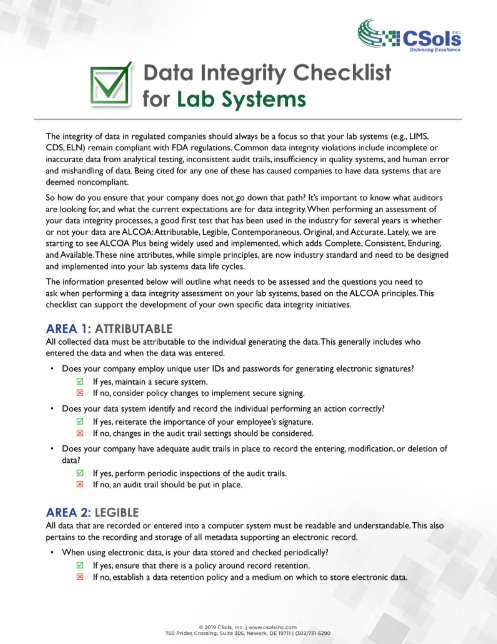
A scientific data management system (SDMS) or data platform plays a key role by capturing raw instrument data directly, ensuring that original data is preserved in line with data integrity principles such as ALCOA+. In concert with the SDMS or platform, ELN and LIMS maintain structured records of experiments and sample data.
Together, these systems create a reliable data environment where every action is recorded and traceable, supporting both operational accuracy and regulatory expectations.
{{cta:data-integrity-checklist-for-lab-systems}}
Plan for Compliance from Day One
Compliance requirements are a critical consideration for laboratories in regulated industries such as pharmaceuticals, biotechnology, and food testing. Regulations from authorities like the U.S. Food and Drug Administration (FDA) or Health Canada, along with standards such as 21 CFR Part 11, ISO/IEC 27001, and GxP guidelines, require secure data handling, traceability, and controlled documentation.
When lab informatics solutions are implemented early in the design process, compliance becomes part of the workflow rather than an additional effort. Systems can enforce role-based access, maintain electronic signatures, and generate complete audit trails.
This ensures that every action performed within the lab is recorded and can be reviewed when required. Instead of preparing for audits retrospectively, laboratories maintain continuous audit readiness.
Building compliance into the foundation reduces risk and ensures that laboratory operations align with regulatory expectations from the start.
Enable End-to-end Data Traceability with Integration
Traceability is essential for understanding how data is generated and validated. In a well-designed laboratory, every result should be linked back to its source, including the sample, method, and analyst involved.
Analytical instruments generate large volumes of data, and manual handling of this data can introduce delays and errors. Integrating lab informatics systems provides traceability by connecting structured experiment, sample, and result data within a unified platform. LIMS manages sample lifecycles, ELN documents experimental context, and SDMS preserves raw instrument data.
This interconnected structure eliminates the need to search across multiple systems and records. A clear and complete view of all laboratory data is immediately available for review, eliminating risks from manual transcription. Traceability and integration not only support regulatory compliance but also avoid data silos and improve operational insight and decision making.
Integration ensures that all stakeholders have access to consistent and accurate data while maintaining appropriate access controls required for compliance. Eliminating data silos improves collaboration, reduces duplication of effort, and ensures that decisions are based on complete and reliable information.
Integration also enables more automated systems. Automation guides users through predefined processes, reducing the likelihood of missed steps or inconsistencies. This leads to more reliable outcomes and faster turnaround times. Researchers can focus on analysis and innovation rather than repetitive administrative tasks.
Design for Scalability and Flexibility
Laboratories are dynamic environments where requirements evolve over time. New methods are introduced, data volumes increase, and teams expand.
An effective lab informatics solution must be able to adapt to these changes. Scalable systems allow laboratories to handle increased workloads without compromising performance.
Flexibility is equally important. Systems should support configuration of new workflows, data structures, and reporting requirements without extensive redevelopment.
This adaptability ensures that the laboratory can respond to changing needs while maintaining efficiency, consistency, and compliance.
Plan for Integration with Business Systems Beyond the Lab
Laboratory operations are closely connected to broader organizational processes. Data generated in the lab often needs to be shared with production, quality, and management systems.
Integrating lab informatics platforms with enterprise systems such as enterprise resource planning (ERP) software or a quality management system (QMS) ensures seamless data exchange and improved coordination.
For example, test results can be automatically shared with production teams, enabling faster decision making, while quality teams gain direct access to laboratory data for oversight and compliance.
Planning these integrations during the initial setup ensures that the informatics platform can support cross-functional workflows and organizational requirements.
Lab Planning Begins with Informatics
Designing a new laboratory provides a unique opportunity to establish a strong digital foundation. By focusing on workflow design, data integrity, compliance, and scalability, organizations can create an environment that supports both current operations and future growth.
Lab informatics solutions such as LIMS, ELN, and SDMS enable structured workflows, reliable data management, and seamless integration across laboratory and business functions while supporting regulatory frameworks.
The result is a laboratory that operates efficiently, maintains high standards of data integrity, and is well prepared to support evolving research and regulatory demands.
Planning a new lab or upgrading your informatics systems? Scalable, compliant solutions aligned with your lab requirements exist.



.jpg)
.png)
.png)

Comments